
Distribution days have accrued across major averages and leading stocks. The weak bounce on lower volume underscores this.
### Possible Downside Scenarios
| Scenario | SOX Target | Nasdaq Target | Probability | What Would Drive It |
|---|---|---|---|---|
| Mild / Base Case | 11,500 – 11,800 | 24,800 – 25,200 | High | Normal digestion after big run + rotation + retest of recent lows |
| Moderate | 10,800 – 11,200 | 24,000 – 24,500 | Medium‑High | Continued AI spending concerns + weak follow‑through |
| Deep Correction | 10,000 – 10,500 | 23,000 – 23,500 | Medium | Earnings misses + macro deterioration |
| Bear Market | Below 10,000 | Below 22,000 | Low | Major capex cuts or recession fears |
### Current View
- **SOX** has already given back a meaningful chunk. Another **8–12%** lower (into the **11,000 – 11,300** zone) would be a fairly normal correction after the massive rally we had. Going below **10,800–11,000** would start looking more serious.
- **Nasdaq** is less extended than the SOX, so it has less downside in percentage terms. A drop into the **24,500 – 24,800** area would be a reasonable next leg if semis keep weakening.
- These levels assume we’re in a **correction within a bull market**, not a cycle top. If AI capex guidance stays strong and we don’t get major negative surprises in earnings, the damage should be limited.
### What Would Make It Go Much Lower?
- Clear signs that hyperscalers are slowing AI capex.
- Multiple big semiconductor names missing earnings badly.
- Broader market breakdown ( Nasdaq breaking key support with high volume).
### What Would Stop the Decline?
- Strong bounce with increasing volume.
- Positive comments from big tech on AI spending.
- SOX holding the **11,800 – 12,000** zone on a closing basis.
**Bottom line**:
A further **8–15%** decline in the **SOX** (into the low 11,000s) and **5–10%** in the **Nasdaq** is quite possible in a normal correction in context of a bull market. Going significantly beyond that would require a deterioration in the fundamental AI story, which we haven’t seen yet.
Keep in mind we have inflation reports 7-14 (CPI), 7-15 (PPI) which could affect the Fed's mildly hawkish stance.
We also have two major semiconductor stocks, TSM and ASML, reporting earnings before the open on 7-16 and 7-17, respectively. These two companies give the market insight into both current demand (TSM) and future supply capability (ASML) across the semiconductor sector. This makes them more important than many names in the SOX.
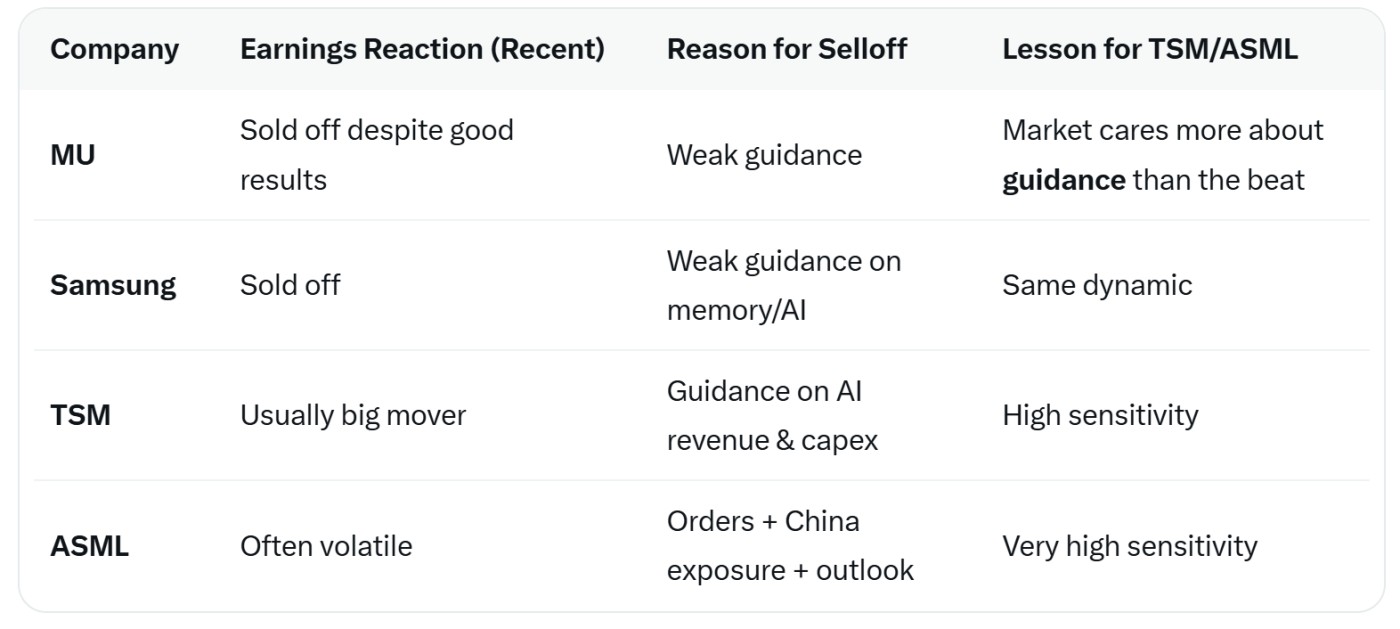
TSMC is more likely to guide above expectations when it reports on July 16, while ASML has a more mixed outlook when it reports on July 17.
### TSMC (TSM)
TSMC has a relatively high chance of coming in ahead of expectations or raising its full-year guidance. The company has a track record of being conservative with its forecasts and then beating them. Recent monthly revenue has been very strong, with June coming in particularly well, and the second quarter is tracking toward the high end of its previous guidance range. AI-related demand, especially for advanced nodes and advanced packaging (CoWoS), remains robust according to management’s prior comments.
The key things investors will be watching are whether TSMC raises its full-year 2026 revenue growth target above the current “above 30%” level and what it says about CoWoS capacity constraints. Most analysts expect some form of positive surprise or an upward revision to guidance.
### ASML
ASML’s report on July 17 is expected to be more mixed. The company already raised its full-year 2026 revenue outlook significantly during the first-quarter results, so the bar is somewhat higher this time. While AI demand continues to support the business, ASML tends to be more cautious in its tone compared to TSMC.
The market will focus on whether ASML maintains or slightly improves its full-year revenue range and how it comments on bookings, particularly for High-NA EUV tools. A solid beat is possible, but a major upward revision in guidance is seen as less likely than with TSMC.
### Overall Takeaway
TSMC carries more weight for the semiconductor sector and has a clearer path to surprising positively. ASML is more of a “don’t disappoint” situation after its earlier guidance raise.
If TSMC raises its full-year outlook while ASML stays relatively steady, it should provide some support to the SOX and Nasdaq. However, if both reports come across as cautious, it could reinforce the recent technical weakness in semiconductors.