
**TSLA and GOOGL Q2 2026 Earnings – Both Gapping Lower**
Both companies reported after the market close on **July 22, 2026**, and both stocks opened lower in after-hours/extended trading.
### Tesla (TSLA) – Mixed Results, Focus on Future Bets
- **Revenue**: Beat expectations (~$28.2B vs. ~$26–27B est.)
- **EPS (adjusted)**: Missed (~$0.33 vs. ~$0.50–0.55 est.)
- **Key Concerns**: Higher capex (heavy AI/autonomy investment), profitability miss, and questions about when the big AI bets will pay off.
### Why Both Gapped Lower
- **AI Capex Fatigue** — Both companies are spending massively on AI infrastructure. The market is questioning near-term returns vs. the huge costs.
- **Profitability vs. Growth Narrative** — Investors are rotating toward companies showing clearer, more immediate profits rather than “future bets.”
- **Broader Market Sentiment** — Tech/AI stocks have been volatile, with recent pullbacks on valuation worries.
**Bottom line**: Both beats on top-line revenue, but the market is punishing them on margins, spending levels, and the “when does the AI payoff come?” question. Classic post-earnings rotation/sell-the-news reaction.
**Cash to Burn: The AI Race Demands It**
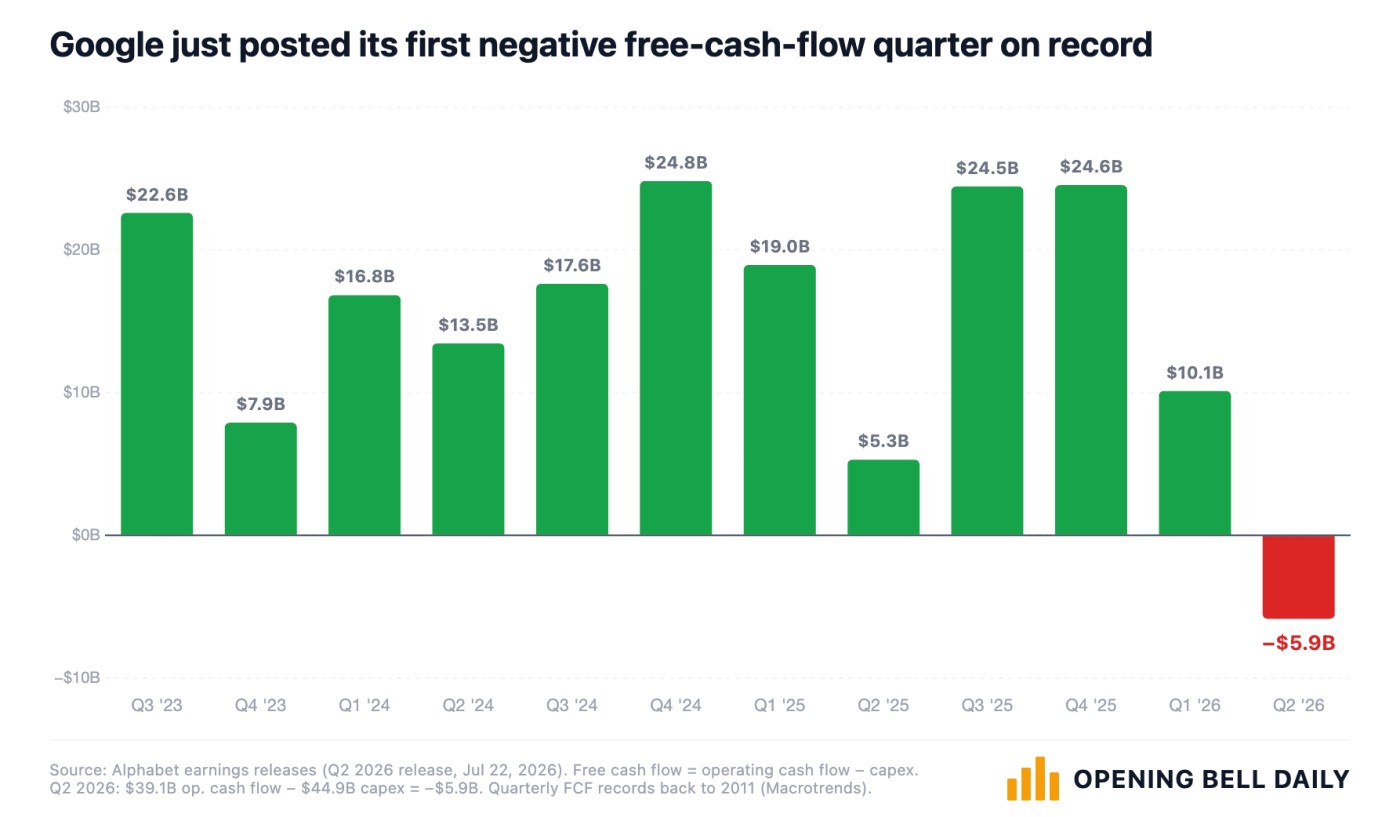
Alphabet delivered blowout earnings — yet burned cash for the first time on record.
Free cash flow turned negative at **-$5.9 billion**, as capex doubled to $44.9 billion on AI infrastructure.
They’re financing aggressively: $49.6B stock raise, $20.3B in notes, and nearly doubling long-term debt in six months.
Critics say companies aren’t profiting enough relative to the spending. Fair in the short term. But this is an **arms race**.
The winners won’t be the most frugal. They’ll be the ones who spend the **smartest** (and often the most) in the areas that deliver massive profits years ahead — compute, data centers, energy, and models.
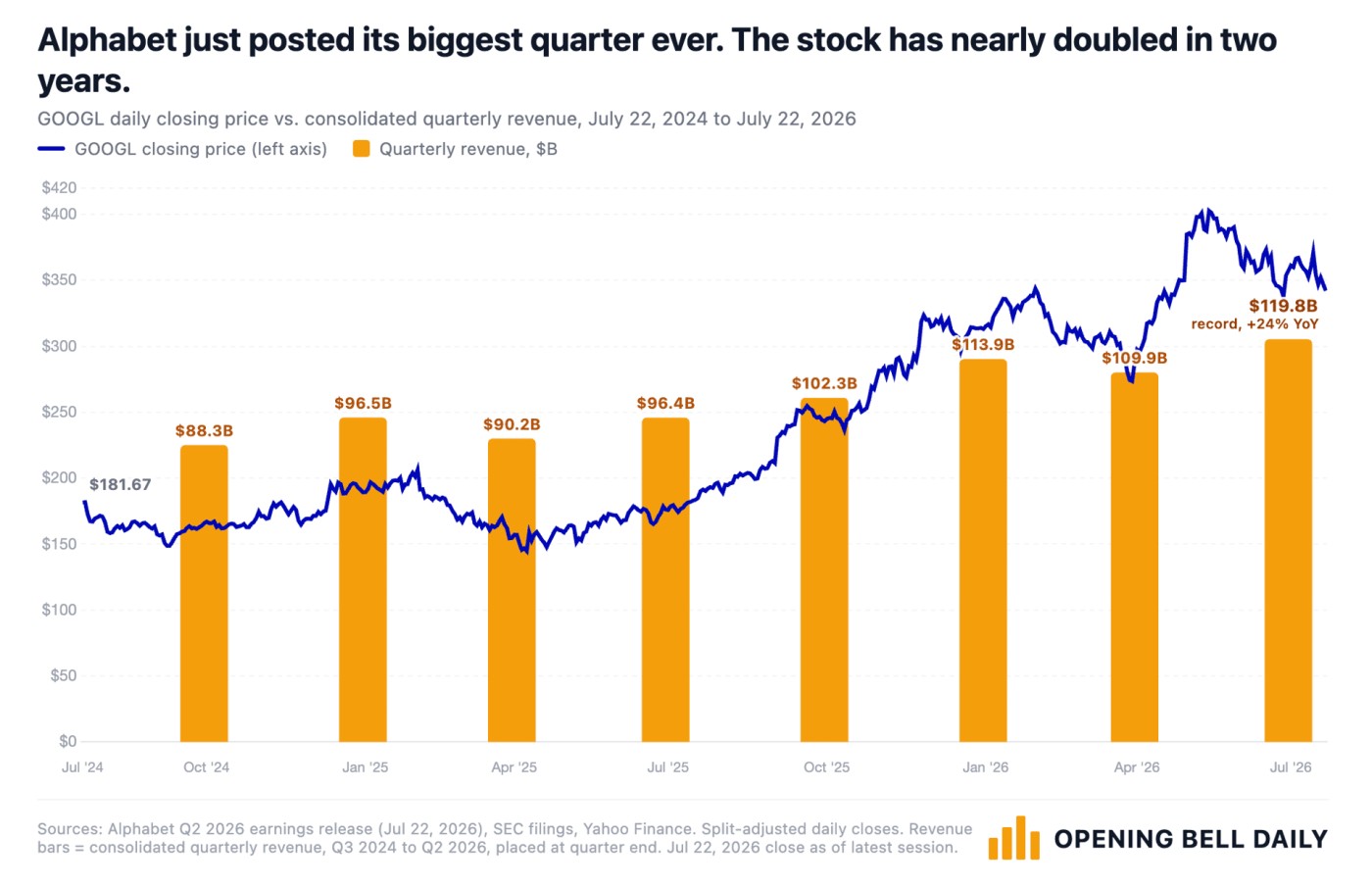
The core business remains strong: Revenue +24% to $119.8B, Cloud +82% to $24.8B, and record profits.
Circular Demand Creation
Major tech companies (Nvidia, Microsoft, Google, etc.) are not just selling products to AI companies — they are also investing in them. This artificially boosts demand for their own chips and cloud services. Examples include Microsoft’s investment in OpenAI and Google’s large commitments to Anthropic.
1. **Real Demand Exists and Is Growing**
- Companies are already seeing measurable ROI from AI in areas like software development, customer support, and content creation.
- Unlike the telecom bubble in the early 2000s, there is **actual usage and revenue** being generated today.
2. **Big Tech Has Real Balance Sheet Strength**
- Microsoft, Google, Amazon, and Meta generate **hundreds of billions** in free cash flow annually. They can easily afford to continue funding AI even if returns take longer than expected.
3. **The Structure Is Different from Past Bubbles**
- In the 1990s telecom bubble, companies were financing **customers** who had weak business models.
- Today, the biggest spenders (the hyperscalers) are also the ones with the strongest businesses and deepest pockets.
4. **AI Has Multiple Layers of Value**
- Even if some GPU investments underperform, the **software, data, and models** created have lasting value. This is different from laying fiber that might never be used.
5. **Innovation and Efficiency Gains Are Real**
- AI is already reducing costs in software development and operations. These efficiency gains can eventually support higher spending.
Still, investors are growing impatient because AI spending is currently running far ahead of visible profits. Some see it as a warning sign that the massive spending may not be sustainable long-term, or that it could pressure stock valuations if the returns on this investment don’t materialize quickly enough. While companies like Nvidia, TSMC, and ASML are already generating strong returns by selling the tools needed to build AI, most other companies are still in a heavy investment phase with limited near-term payback. This creates a classic mismatch: big upfront costs today in exchange for potentially much higher profits later. Amazon is a good example — it lost money for years while aggressively building its business, yet delivered massive long-term returns to patient investors. During the dot-com boom, its losses attracted numberous short sellers yet AMZN continued to hit new highs. It was also one of the first key stocks that issued a pocket pivot entry point in March 2003, but this came shortly after the worst bear market in the history of the NASDAQ Composite. With AI valuations already very high, many investors today are less willing to wait for that payoff.
Further, the rate outlook feels uncertain right now — we’re in a tug-of-war between sticky services inflation and deflationary AI/tech forces. The odds of a rate hike at the next Fed meeting jumped. The Fed is currently focused on the demand side and near-term inflation prints, which is why a second hike this year is also being priced in. But once the productivity gains show up more clearly in the data (lower unit labor costs, falling goods prices), the narrative can flip quickly toward cuts. Indeed, the PPI came in well below estimates. It reinforces that supply-side forces (AI efficiency, lower goods prices, productivity gains) are actively pulling inflation lower.
For now, keep an eye out for weak bounces into resistance for short sale set-ups as well as potential bottoms in major averages especially the SOX and NASDAQ Composite indices should they emerge. Pocket pivots, undercut & rally formations, volume dry-ups, and buyable gap ups (even if well off highs) may become actionable.