
Anthropic's IPO
Anthropic filed its S-1 for a Nasdaq listing under the ticker ANT. The filing gives investors a clearer look at the company’s finances, its unusual ownership structure built around the safety mission, and the risks it flags around building more capable AI systems.
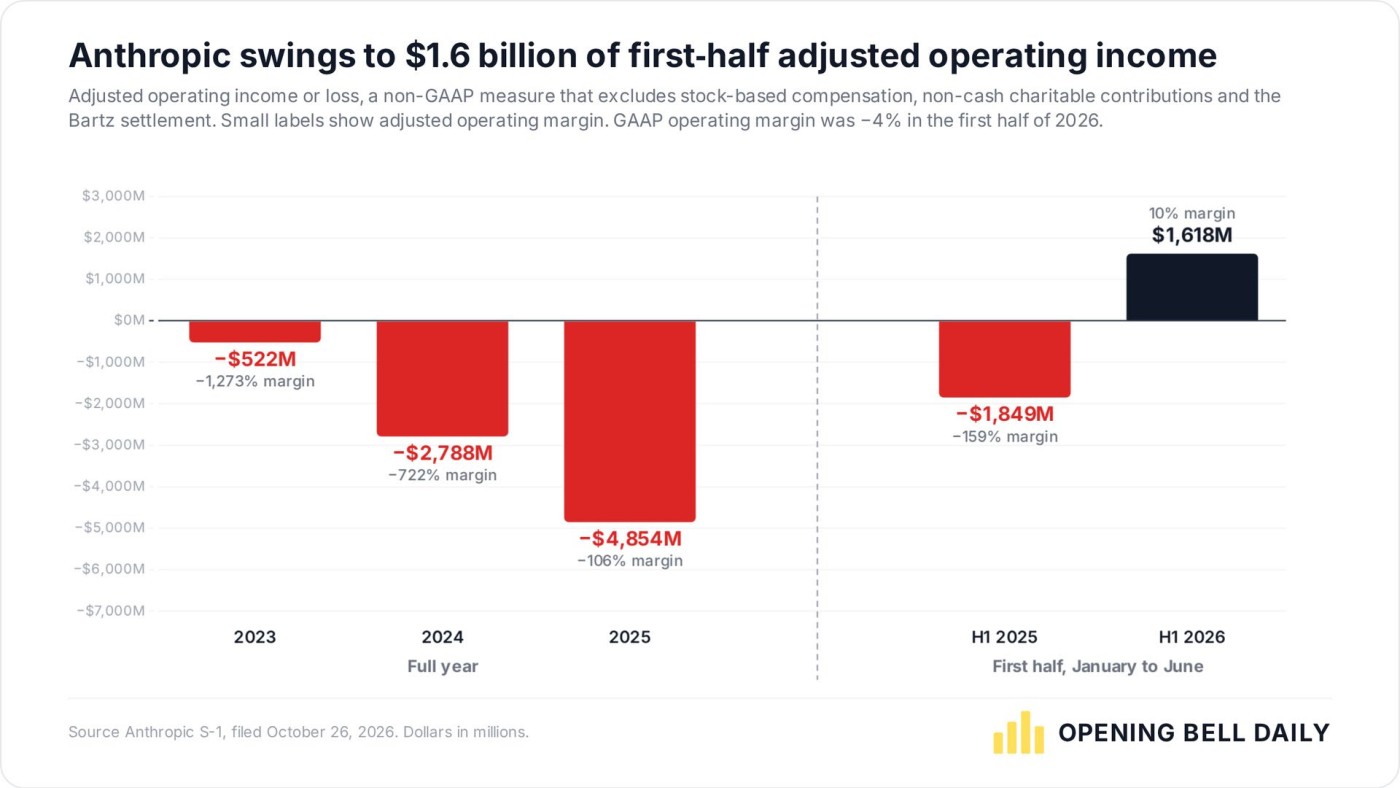
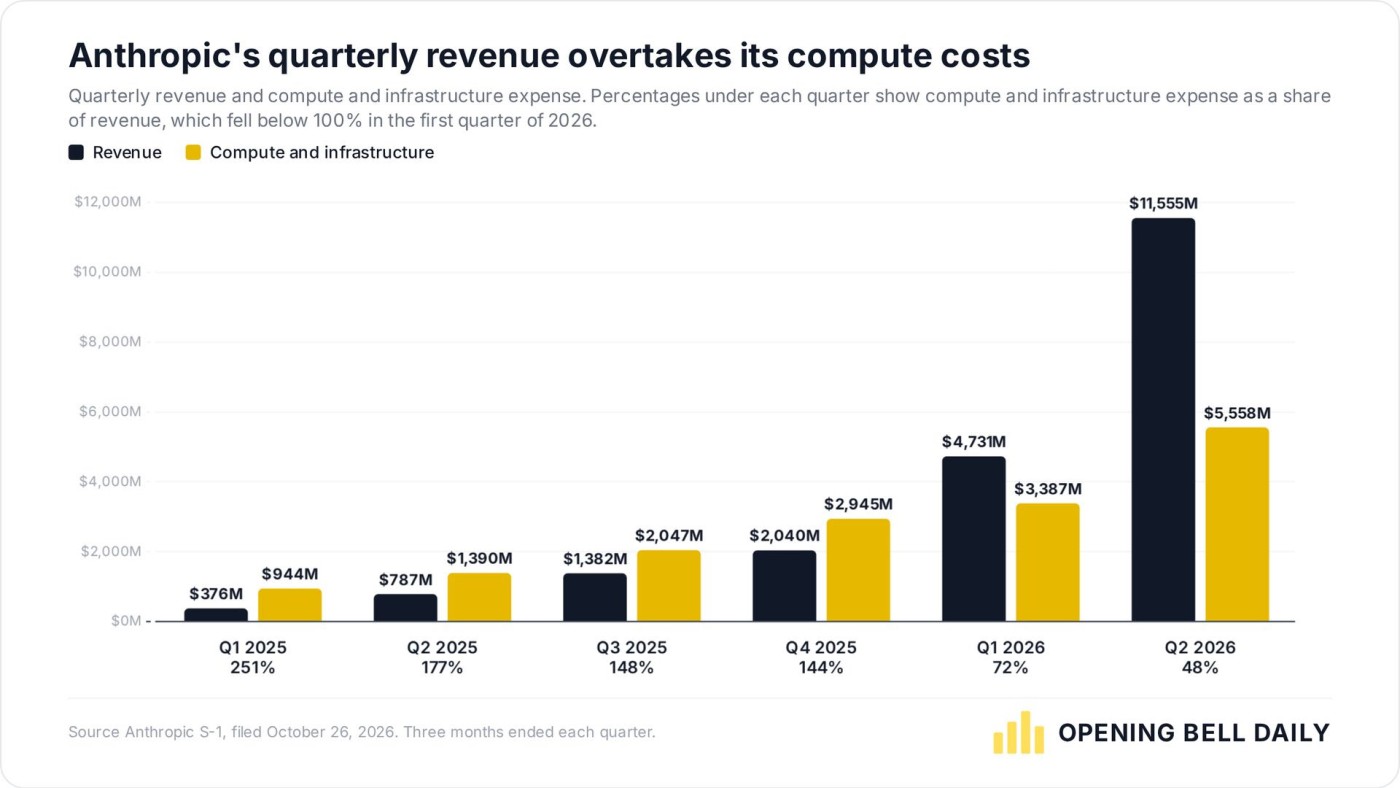
Revenue reached $1.63 billion in the first six months of 2026, roughly 14 times higher than a year earlier. The June quarter alone produced $974 million in operating profit. Anthropic has raised $141 billion to date but still holds about $132 billion of that capital, meaning it has spent a net of roughly $9.4 billion to build a business now generating $11.6 billion in a single quarter.
Compute costs relative to sales have also come down sharply. By the second quarter of 2026, compute and infrastructure expenses equaled 48 percent of revenue, down from 251 percent in the first quarter of 2025.
Anthropic has disclosed major long-term commitments with Amazon, Google, Microsoft, SpaceX’s AI unit, and others that together total close to $650 billion over the coming years, while customers generating at least $100,000 in trailing revenue grew to more than 11,900 as of September 30, up from about 1,500 at the end of 2025, with no single customer accounting for more than 10 percent of revenue.
None of this makes the IPO a sure thing, but the numbers do show an AI lab whose revenue is finally catching up to its ambitions, even as its compute commitments stretch years into the future. Indeed, the big knock on AI was that the businesses wouldn’t hold up, but Anthropic just showed a profitable quarter with almost all the raised cash still in the bank. The debate now shifts from whether the business can work to how large ANT can grow once trading begins.
Anthropic is expected to grow by huge amounts. Co-founder Jack Clark has highlighted rapid capability gains (e.g., Humanity’s Last Exam scores rising from 8% to nearly 68%) and internal models suggesting AI could help push U.S. GDP toward $44 trillion by 2030 under aggressive scenarios, as AI accelerates scientific discovery and knowledge work across a $40 trillion-plus addressable market. The company frames this as the diffusion of AI through the global economy—one of the largest opportunities in history—while committing hundreds of billions to compute infrastructure to sustain the trajectory.
In a similar vein, Elon Musk’s near-term predictions for SpaceX center on rapid revenue scaling rather than a specific GDP share. On the October 2026 earnings call he said the company’s annual recurring revenue could reach $500 billion to $1 trillion by the end of 2027, driven primarily by AI compute (Super Intelligence) and Starlink expansion. He later posted that $1 trillion in SpaceX revenue in 2028 is “no longer impossible,” pulling forward earlier internal targets that had pointed to $1 trillion around 2030 (with a non-zero chance in 2029). These figures imply SpaceX would become one of the largest companies by revenue within a couple of years, though Musk has not issued a precise near-term estimate of its contribution to global GDP.
China, Gold, and Bitcoin: Liquidity Still Rules
Money still matters, and expanding global liquidity remains the dominant driver of asset prices. The biggest winners continue to be monetary inflation hedges—gold and Bitcoin—because this regime is not a temporary policy mistake. It is structural.
We are in the early stages of Capital Wars: nation-states play a larger role, fiscal needs dominate, and monetary policy is subordinated to funding those needs (Keynesian dominance). Under this setup, monetary inflation is not an error; it is a tool. Financial repression cuts the income on savings. Monetary inflation erodes the real value of the savings themselves. One reduces yield; the other destroys accumulated wealth.
Gold’s driver is still China. China carries a heavy debt load with sluggish growth and subdued inflation. The historical response is monetary expansion and currency debasement to lower the real burden of debt. Strict capital controls limit alternatives, so domestic demand has funneled into gold. PBoC liquidity has shown a meaningful relationship with the gold price, leading it by roughly nine weeks on weekly changes. Recent data are mixed- liquidity slowed around Iran tensions, rebounded after the MoU, and remains only modestly positive- but the structural bid from China has not gone away.
Bitcoin is more sensitive to global liquidity momentum. It has shown roughly five times the sensitivity to Global Liquidity versus gold. Global Liquidity is still expanding in absolute terms, but the growth rate is slowing. That slowdown has historically weighed on Bitcoin performance. Part of the moderation comes from the Fed fine-tuning money-market conditions while keeping reserves adequate and repo markets stable. Near-term liquidity support looks less robust than it was earlier in the cycle.
The strategic case for monetary inflation hedges remains intact even if the short-term tactical picture is mixed. Weakness in gold and Bitcoin continues to look more like a buying opportunity than a reason to abandon the thesis. Global debt keeps expanding exponentially. Financial stability ultimately requires liquidity to grow alongside debt. That points to ongoing monetary inflation as a persistent feature of the landscape which is not the same thing as consumer-price inflation, and not merely financial repression.
Leading stocks also stand to benefit. Despite AI worries, sticky inflation, potential rate hikes, and oil price swings, rising global liquidity has historically supported high-relative-strength names with strong earnings and institutional sponsorship. These stocks tend to absorb the liquidity first and outperform even when macro headlines stay noisy. The same debt-driven need for more liquidity that supports gold and Bitcoin continues to underpin leading stocks.
In this environment, gold and a volatility-weighted gold-Bitcoin basket are not optional portfolio diversifiers. They are increasingly essential. Monitor price action for durable bases, and stay positioned for the liquidity-driven advance that history and the debt math continue to favor.