
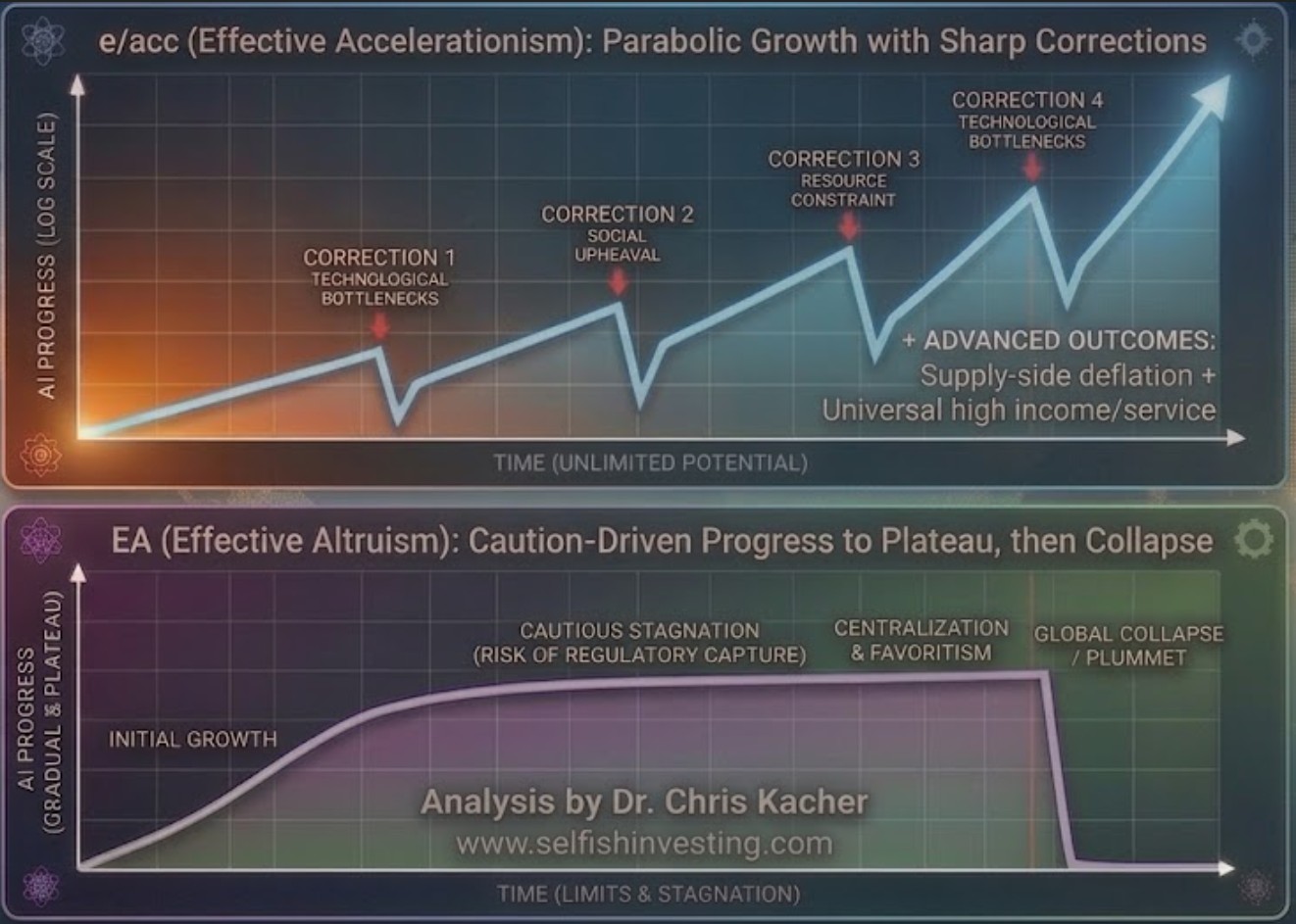
 [Figure: e/acc results in sharp corrections but exponential progress overall. EA results in regulatory capture, stagnation, and the inevitable sharp power imbalance with control over AI to the few over the many.]
**Why I Lean e/acc Over EA — And Why Decentralization Still Wins**
The debate between Effective Altruism (EA) and Effective Accelerationism (e/acc) isn’t just some niche internet argument. It’s becoming one of the most important philosophical and practical fights of our time, especially as AI accelerates.
I’ve spent time in both camps intellectually. I respect the intent behind EA. But when you look at the actual track record of centralized power, human nature, and where technology is heading, the e/acc framework makes more sense to me.
The Core Problem With EA
EA’s biggest weakness is that it tends to trust institutions and expert gatekeepers too much. The logic usually goes like this: *AI is extremely powerful and dangerous, therefore only the most responsible actors should be allowed to build it, and we need strong oversight to keep things safe.*
That sounds reasonable until you remember how power actually works.
Humans are fallible. Institutions are made of humans. And as Lord Acton said, absolute power corrupts absolutely. When you concentrate the development of the most powerful technology in history into a small number of labs, governments, and regulators, you’re not reducing risk; you’re just moving it. You’re creating single points of failure and massive incentives for regulatory capture.
We’ve seen this movie before. Every time we’ve given small groups of people enormous control “for the greater good,” it eventually gets abused or ossifies. EA tends to underestimate this because it assumes the people in charge will remain wise and benevolent. History says otherwise, and is one of the fundamental reasons why communism failed so spectacularly. It wasn’t just bad economics; it was the arrogant belief that a small group of planners could centrally direct an entire economy without eventually becoming corrupt, incompetent, or both. The same pattern shows up in government-created monopolies, heavily regulated industries, and now in proposals to tightly control advanced AI development.
The Case for e/acc
e/acc starts from a different premise: progress is the best defense against risk. Instead of trying to slow things down and centralize control, you accelerate and decentralize.
This doesn’t mean being reckless. It means recognizing that:
- Competition creates better outcomes than central planning.
- Open systems are harder to corrupt than closed ones.
- The fastest way to solve hard problems (including alignment) is usually through rapid iteration and broad participation, not through a small priesthood of experts. None of us is as smart as all of us,
The e/acc view also aligns better with what we’ve actually seen from technology. Every major technological leap — electricity, computing, the internet — created new risks. But the net effect was overwhelmingly positive because progress compounds. Trying to centrally manage these transitions has almost always led to worse results than letting competition and adaptation play out.
Elon’s Predictions Matter Here
Elon has been saying for years that we’re heading toward a world with **billions of humanoid robots**. If he’s even directionally right, this changes everything about economics.
When you combine advanced AI with cheap, abundant physical labor (robots), you get **supply-side deflation** on a scale we’ve never seen. Goods and services that are currently expensive become dramatically cheaper. This is the kind of deflation that actually raises living standards rather than the destructive kind caused by collapsing demand.
EA tends to worry that this kind of abundance will be dangerous or destabilizing. e/acc sees it as the point. The goal isn’t to carefully manage scarcity forever. The goal is to make scarcity less relevant.
I think Elon is probably underestimating how fast this could happen in some areas and overestimating it in others. But the direction feels right. And if we’re moving toward a world of radical abundance, then the philosophy that wants to slow things down and centralize control starts looking even more misguided.
Centralization vs Decentralization
The strongest argument against heavy centralization isn’t philosophical — it’s practical. Humans are corruptible, short-sighted, and status-seeking. Any system that gives a small group of people (whether in government or a handful of AI labs) permanent control over something as powerful as advanced AI is eventually going to be gamed.
This is why I believe **decentralization** is the more robust path forward.
We’re already seeing this dynamic play out with Bitcoin. Many people assumed that once governments and institutions understood Bitcoin, they would either ban it or fully capture it. Instead, Bitcoin has continued to exist alongside fiat systems. It hasn’t replaced the dollar, and it probably won’t anytime soon. But it also hasn’t been eliminated despite numerous attempts to ban it and its miners. The two systems coexist, and each serves different purposes.
I expect something similar with AI. There will be heavily regulated, centralized AI systems run by big labs and governments. At the same time, decentralized and open-source AI will continue to develop in parallel. China supports this while the U.S. may take a more cautionary approach which would put China way ahead. The centralized systems will likely be more powerful in certain narrow domains. The decentralized ones will be more resilient, harder to censor, and better at avoiding single points of failure.
Trying to stop the decentralized path is probably futile. More importantly, it would be a mistake. The same forces that make Bitcoin useful (censorship resistance, transparency, no single point of control) will make decentralized AI valuable too.
The Practical Reality
We’re not going to get a pure e/acc world or a pure EA world. What we’ll get is messy coexistence.
Centralized systems will continue to exist because they’re good at certain things (coordination at scale, massive capital deployment, regulatory compliance). Decentralized systems will grow because they’re better at resisting capture and single points of failure.
The real danger isn’t acceleration itself. The real danger is letting the people who are most afraid of losing control write all the rules. That almost always leads to systems that protect incumbents and slow down genuine progress.
I’d rather live in a world where AI advances quickly and unevenly, with all the messiness and short-term problems that come with it, than in a world where a small group of institutions gets to decide how fast the future is allowed to arrive.
The track record of centralized control over transformative technology is poor with all the government-led artificial monopolies created since the 1930s with Bell Telephone. For decades, it was granted a near-total monopoly on telephone service in the United States. The justification was always the same: this was a natural monopoly, and only centralized control could deliver reliable service. In reality, it slowed down innovation for generations.
Indeed, the track record of decentralized competition and rapid iteration is much better. That’s why, despite respecting the intent behind EA, I continue to lean toward the accelerationist side of this debate.
Original (and other articles) here: https://chriskacher.substack.com/p/eacc-effective-accelerationism-vs