
by Dr. Chris Kacher
Iran forgotten?
Despite the Iran conflict and oil prices that had been surging, the market remained remarkably resilient. The market is ignoring higher rates and volatility in the price of oil because it is laser-focused on AI as the single biggest story. AI is a structural tailwind that is already driving productivity higher and lowering costs in multiple sectors. The geopolitical noise is temporary. The market is voting loudly with its price action. Until we see real cracks in the AI story, stocks will likely keep moving higher across semiconductors, data centers, power, large tech, and many other verticals.
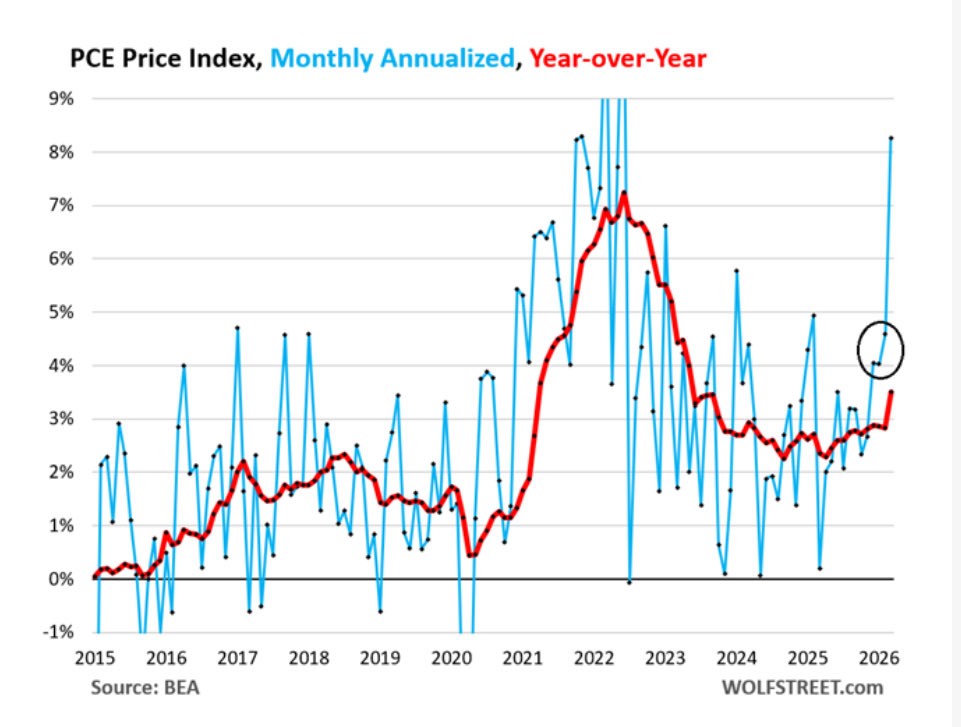
So dont let charts like the one showing the PCE spiking on a monthly annualized basis scare you since it can jump around a lot from one month to the next. The Cleveland Fed’s nowcasting data shows March 2026 monthly annualized PCE at 8.3%, but its median PCE inflation trend was still around 2.8%, which suggests the underlying trend was much calmer than the raw monthly burst. The longer-term inflation trend is not nearly as extreme as such charts suggest. Markets can still react to that number because the Fed watches PCE closely, but it’s wiser to focus on the 3.5% YoY headline and 2.4%–3.2% core/trend measures than the one-month annualized jump alone.
AI bottlenecks?
That said, the bottlenecks are real and they’re here right now, but AI is already starting to solve them. Because it’s recursive, it’s generating solutions that go far beyond its original training data. AI is evolving at breakneck speeds.
Remember AlphaGo’s famous move in the championship Go match? It didn’t just optimize within known strategies — it discovered something entirely new shocking the best players. That’s the shift we’re seeing in science today.
We now have autonomous AI agents that generate hypotheses, design experiments, run lab equipment, analyze results, and iterate at machine speed with almost no human input. They’re exploring possibility spaces no human team could cover in a thousand lifetimes.
AlphaFold solved the 50-year protein folding problem and mapped the structure of virtually every known protein. Its successor, AlphaEvolve, just had its own AlphaGo moment by discovering a brand-new, more efficient way to do matrix multiplication — a fundamental operation that powers all of modern AI.
Lila is now building fully autonomous “AI Science Factories” that do exactly this at scale. Their system, trained on just 2% of available scientific data, is already outperforming the latest Claude and GPT-5 models across materials science, chemistry, and life sciences.
In CAR-T cell therapy, an AI-driven program spent $3 million and six months to develop a superior therapy after exploring 300,000 design variants. A competing traditional approach took years, cost $2.1 billion, and only tested 13 variants. A massive difference.
This is what happens when the scientific method compounds at machine speed.
Every scientist will soon have an AI collaborator that can read the entire literature in seconds, generate novel hypotheses, design experiments, and iterate faster than any human ever could. The real question is no longer whether AI can help with research. It’s how we ever did research without it.
That said, the bottlenecks are **real and will cause volatility and slower near-term rollout** (exactly what we saw in the April 29 earnings reactions and the capex fatigue).
**2026 – early 2027**: Noticeable slowdown.
Power and infrastructure bottlenecks are hitting hard. Many large training runs are being delayed or scaled back. Progress shifts toward efficiency, agentic systems, and smarter architectures rather than raw scaling.
**Mid-2027 – 2028**: The crunch begins to ease.
AI-driven improvements in design, materials, and grid optimization start compounding. Recursivity helps shorten the worst of the bottleneck, so the slowdown is less severe and shorter than a pure physical view would suggest.
But this slowdown is viewed as a **temporary speed bump**, not a structural limit. Further, the timeline may be moved up since the pace of evolution continues to accelerate.
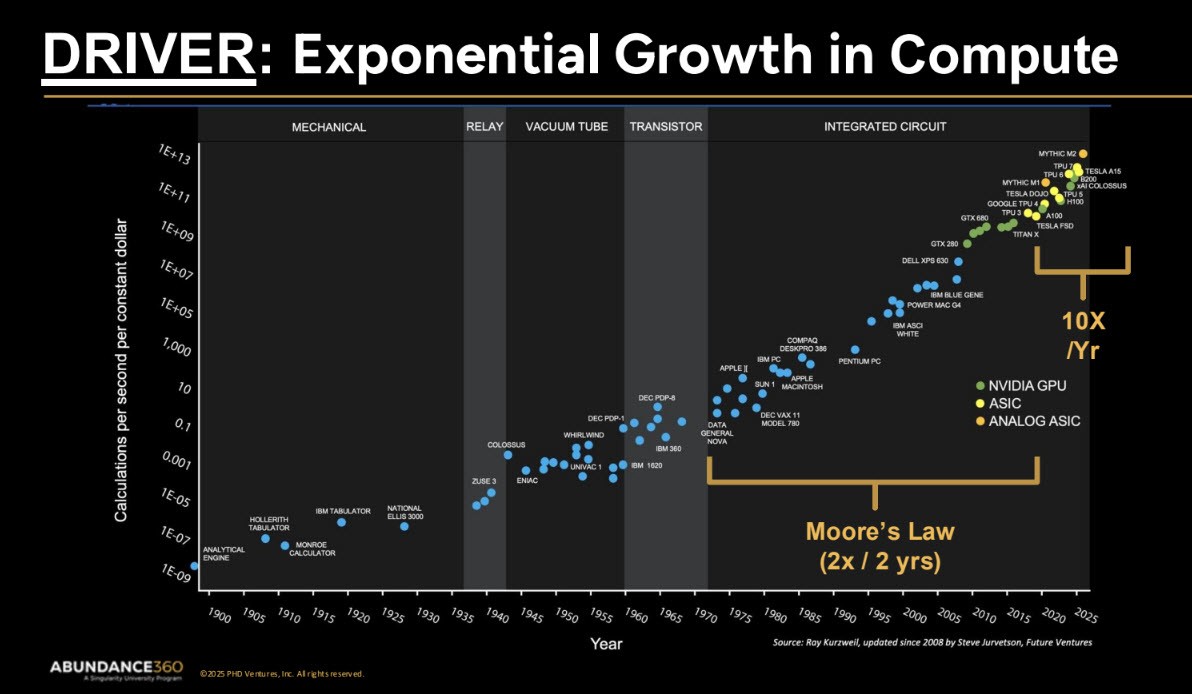
Also, other metrics may continue to climb. The chart’s long-term view assumes these issues will be overcome — just as every previous bottleneck was — so the overall exponential trend in compute-per-dollar continues.
Is the Big Tech/Hyperscaler AI Capex Buildout Sustainable or a Bubble?
Bulls:
Massive spending (~$600–700 billion+ projected for 2026 by Amazon, Microsoft, Google, Meta, etc.) on data centers, chips, energy, and networking is real and unprecedented.
- Demand is structural: AI training and inference needs are exploding. Revenue from AI services (Azure, AWS, Google Cloud) is growing fast and starting to offset costs. AI use cases (reasoning agents, enterprise automation, scientific discovery) are expanding faster than many expected. Cloud AI revenue is ramping and beginning to offset the spend.
- Long payback but real: Data centers have 10–15+ year useful lives. Energy efficiency improvements and custom chips (e.g., Google TPUs, Amazon Trainium) help ROI.
- Network effects: Winners (hyperscalers) get more data, better models, more customers — reinforcing the spend.
- Historical precedent: Cloud buildout in the 2010s looked expensive but paid off hugely.
**2026 – early 2027**: Noticeable slowdown.
Power and infrastructure bottlenecks are hitting hard. Many large training runs are being delayed or scaled back. Progress shifts toward efficiency, agentic systems, and smarter architectures rather than raw scaling.
So the question will be how much of an impact these bottlenecks have since they may be expanded sooner than expected, and markets are always forward looking by typically 6-9 months.
Bottom line:
This is a high-conviction, high-execution-risk growth cycle, not a pure bubble. The bottlenecks are real and will cause choppiness (as we saw recently), but they appear temporary rather than structural. Markets will price in relief 6–9 months ahead of actual resolution, so the path forward depends on how quickly AI-driven improvements compound.
AI cybersecurity top plays
Members will receive real-time reports which are actionable.
While semiconductors have been dominating, the AI-powered cybersecurity group may be next. It is one of the clearest near-term monetization opportunities in AI. As AI agents, deepfakes, automated attacks, and expanded attack surfaces (cloud, endpoints, identity) grow, demand for intelligent, real-time security platforms is exploding. Companies that combine strong AI/ML with established platforms are best positioned. Keep an eye on PANW and CRWD, two of the leaders, for undercut & rally, pocket pivot, or buyable gap ups.
**CrowdStrike (CRWD) and Palo Alto Networks (PANW) are widely regarded as leaders in AI cybersecurity** because they combine massive scale with deep, native AI integration that goes beyond bolt-on features.
**CrowdStrike** stands out with its Falcon platform, which is built from the ground up as an AI-native system. It uses behavioral analysis, massive telemetry from millions of endpoints, and real-time machine learning to detect and stop threats — including sophisticated AI-powered attacks — with high automation and low false positives. Its speed, cloud-native architecture, and ability to orchestrate responses across the enterprise make it a go-to for organizations prioritizing rapid, intelligent threat prevention.
**Palo Alto Networks** excels through its comprehensive platform strategy (Prisma for cloud, Cortex for security operations, and network security). It integrates AI across the entire stack for contextual threat intelligence, automated policy enforcement, and identity security (bolstered by the CyberArk acquisition). PANW’s strength lies in its broad coverage and ability to deliver unified, AI-driven security at enterprise scale, making it ideal for complex, hybrid environments.
Together, they represent the two leading philosophies — endpoint/behavioral intelligence (CRWD) and full-platform consolidation (PANW) — in the shift to AI-powered cybersecurity. Both continue to show strong growth and innovation as the threat landscape evolves.