by Dr. Chris Kacher
Bad is good
Markets have bounced toward new highs despite fears of an AI bubble, more signs of weakness in the labor market, and a Supreme Court battle over tariffs. But "Bad” economic news currently is beneficial to stocks because it raises the likelihood of dovish monetary policy. Also, global liquidity looks to be reaccelerating again after a bout of moderating. Central banks avoid using the politically-charged ‘QE’ but some form is being used. The Fed could take a leaf from China’s playbook, since their Central Bank the PBoC, now uses a long list of monetary acronyms, such as MTL, RRRs, RRPs and now ORRPs, probably to hide what policy makers are really doing.
Supply or demand deflation is key
Global liquidity is driving debt to its highest levels but it is also driving AI and robotics which are squeezing inefficiency out of every corner. Companies can now drive more profits with fewer employees, which is usually referred to as “good deflation.” This is when supply expands faster than demand. But when most think of deflation, they think of the 1930s which was caused by lack of demand and resulted in The Great Depression. But plenty of deflationary periods exist throughout history that were instead supply-driven thus economically bullish. They occurred at major turning points such as:
From 1815-60, prices dropped an average of 1-2% a year due to rapid industrialization and westward expansion. Real GDP rose. In today's world, it is digital expansion due to AI.
From 1873-79 prices fell 3% annually due to increased production in agriculture and technological progress in railroads and steel. Real wages rose and the economy expanded.
In the late 19th century, bouts of deflation arose due to positive supply shocks from the advances in technology.
In all cases, deflation was supply-driven which led to economic growth, not depression.
Since the 19th century, technology has brought prices down and created economic booms. When a major tipping point was reached, supply-side deflation and an economic boom resulted. Exponential growth in AI and robotics are pushing the planet into another tipping point. Elon Musk understands this. That said, neither are yet making a big enough impact on the economy to reach a supply-driven deflationary state due to record amounts of liquidity being created by central banks. But AI and robotics are catching up fast to where Elon’s estimation is that the US economy will hit a supply-driven deflationary period in three years.
Stanley Druckenmiller once said, “Every serious deflation I’ve looked at is preceded by an asset bubble, and then it bursts.” Druckenmiller's claim doesn't hold for 19th-century supply-driven deflations, which were "good deflations" (growth + falling prices from tech/productivity) without preceding asset bubbles, countering his "every serious deflation" generalization.
Recession?As to a looming recession, there have now been 1.2 million job cuts announced in 2025, the second-highest in 16 years, with layoffs currently set to match levels seen in the 2008 Financial Crisis. 60% of Americans say we are in a recession. Yet Polymarket says there is just a 33% chance that the US economy enters a recession by 2027, down ~11% percentage points since October 2025 and at their lowest level yet.
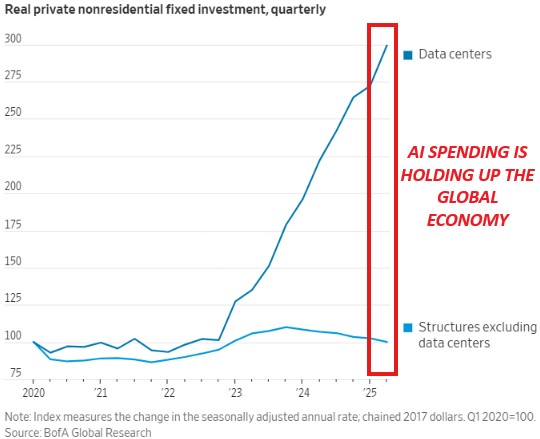
The Atlanta Fed is estimating GDP Q3 growth to be between 3.5% - 3.8% driven mostly by AI. Approximately 63% of all GDP growth is coming from AI-related spending. This means that without the AI CAPEX boom, the US economy would be in a significantly worse position.
In consequence, the S&P 500 is seeing one of its best runs in history. The market just posted its 6th 35%+ rally in 6 months over the last 30+ years.Spending on data centers in the US has tripled since the release of ChatGPT in November 2022 while spending on everything else is down ~20% since the 2023 high. This has created a bifurcated economy.
On the one hand, consumers are struggling from a rapidly declining labor market and high inflation which necessitates a rate cut on Dec 10. On the other hand, the largest US companies doing more with fewer employees are thriving as AI explodes, and rate cuts will add fuel to the fire.