The Mag 7 just wiped out months of flat performance in one session.
Roundhill Magnificent 7 ETF (MAGS) jumped more than 4% on Monday. It had been slightly negative year-to-date through the first seven months. That was the group’s biggest one-day gain since March and one of its strongest sessions on record.
While the S&P 500 needed the full seven months (plus Monday’s 1.5% rise) to post a 10.8% year-to-date return, the Mag 7 were basically flat as recently as last week.
Six of the seven names rallied over 3% each. Apple was the exception, down 1.9%.
What’s driving it
Hyperscaler capex is still projected to rise ~70% this year and top $700 billion. That heavy spending had made the market cautious on the group and compressed the valuation premium of Big Tech versus the rest of the market to multi-year lows. The catch-up trade many were waiting for finally showed up.
Fundamentals for the standouts remain strong:
- Microsoft Azure growing 43% and now above a $100 billion annual run rate
- Amazon AWS up 37% to $42.2 billion
- Alphabet Google Cloud up 82% to $24.8 billion (investors looked past the first negative free-cash-flow quarter)
Microsoft and Amazon both jumped double-digits after their earnings last week. The three companies together added nearly $1.5 trillion in market cap in a single week.
One strong day doesn’t make a trend, but after months of underperformance the Mag 7 now have clearer near-term momentum. The market is currently treating the massive AI capex cycle as a positive catalyst rather than pure risk.
Tech stocks: bulls vs bears for the rest of 2026 and 2027
The debate out to 2027 is straightforward: does the AI buildout keep delivering, or does the bill come due?
The bull case
Hyperscaler capex is still climbing hard. Estimates now point to roughly $700–860 billion this year and $1 trillion-plus in 2027. Cloud growth remains solid—Azure, AWS, and Google Cloud are all posting strong double-digit gains. Semiconductor demand, especially memory and AI accelerators, looks locked in through at least next year.
Valuations have reset. The Mag 7 premium over the rest of the market has compressed to multi-year lows. Earnings estimates for the tech sector continue to rise, and recent results from the big names have mostly reinforced the ROI narrative. If AI monetization (agents, enterprise adoption, cloud services) keeps improving, the cycle has more runway. Selective semis and infrastructure names still look better positioned than pure software.
The bear case
The spending is now large enough to pressure free cash flow. Several hyperscalers are expected to run negative FCF in 2027 as capex outpaces operating cash flow growth. Investors are already more sensitive to every guidance update and every sign that returns are lagging the outlays.
Concentration risk is high. A handful of companies drive a large share of index earnings growth. Any slowdown in AI demand, power constraints, chip supply bottlenecks, a sharper economic soft patch, and/or a slowdown in global liquidity due to materially higher interest rates would hit valuations hard. Some strategists see tech taking a back seat in the second half of 2026, with broader cyclicals leading instead. A few voices flag 2027 as the higher-risk window when growth rates face tougher comps and depreciation from the current buildout starts to weigh more heavily.
Bubbles
The next few quarters still favor the bulls if earnings and capex commitments hold. Beyond that, 2027 looks more contested. The market will demand clearer proof that the massive AI spend is translating into durable profits rather than just capacity. One strong bounce does not settle the argument; execution and ROI will.
The AI bubble didn’t yet burst because the spending is still landing on real demand. Hyperscalers keep raising capex and the revenue is showing up — Azure, AWS, and Google Cloud are all growing 37-82%. Investors stopped punishing the big spenders once the earnings proved the demand was there. As long as the dollars going out are matched by customers actually using the capacity, the trade holds.
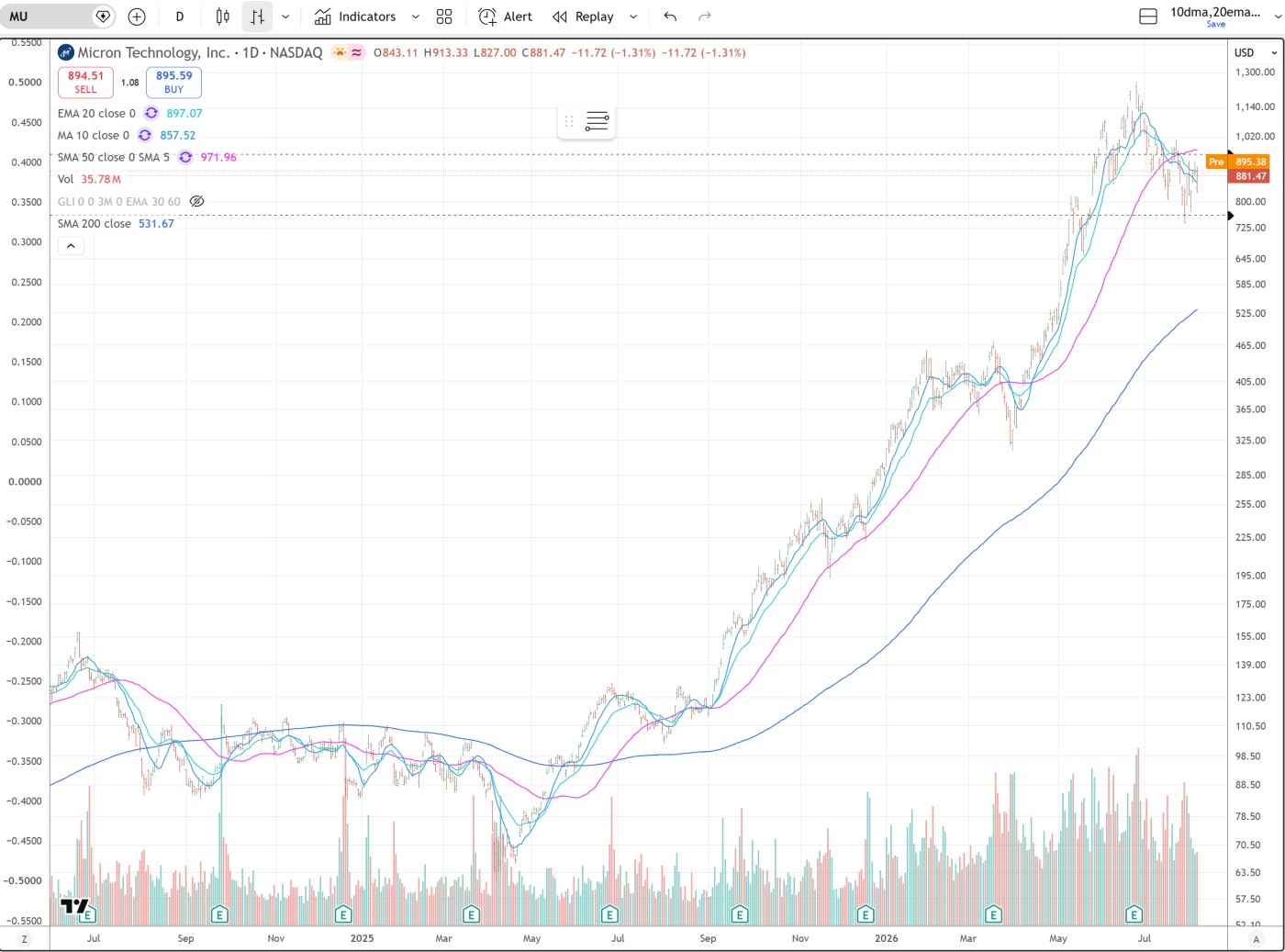
Real bubbles — like the dot-coms or 1929 — put in major tops that don’t get revisited for years. What we’re seeing now is more of a deflation and digestion phase. Demand is still real, hyperscalers are still spending, and more expansion is coming. Stocks that ran 10-30x+ like SNDK and MU are entitled to steep pullbacks. Those drops look ugly in percentage terms but often appear modest on a log chart. Nevertheless, knowing your exit points based on your timeframe is critical. Some use the 10-dma, others the 50-dma as their selling guide.
Price/volume rules all
Don’t assume these high flyers have all topped for good. Watch the price and volume action. That will tell you IF and when the next leg is ready. If prior leading stocks rally weakly into resistance, look for short sale set-ups. If they issue logical entry points, look for entries on the long side. But keep position sizes manageable and stops tight. Stay in the present. Daily key data from leading stocks will underscore market behavior.