
**The 5 Forces of Abundance for the Next Decade**
by Dr. Chris Kacher
At Selfish Investing we cut through the hype and focus on what actually moves prices and protects capital.
Here are five major forces that move the needle:
1. **Artificial Intelligence & Exponential Compute**
This is the most obvious and most powerful force right now. AI is not just another technology cycle — it is a productivity accelerator that is compressing decades of progress into years. The real money is not only in the models themselves but in the entire infrastructure layer that supports them: chips, power, memory, data centers, and networking. We have been positioned in this theme for some time because the liquidity and institutional sponsorship behind it are unmistakable. Expect continued strong leadership from the companies enabling the buildout, with periodic sharp rotations as bottlenecks shift.
2. **Energy Revolution & Power Infrastructure**
AI’s biggest constraint is not chips — it is reliable, abundant, low-cost energy. The data shows hyperscalers are signing massive long-term power agreements and restarting nuclear plants while simultaneously building out solar + storage at record pace. This creates a multi-year tailwind for power generation, transmission, and management companies. The market is already pricing this in, but the real move is still early. Watch for continued pocket pivots and buyable gap-ups in the energy infrastructure names that actually deliver electrons to the AI grid.
3. **Capital Reallocation & Liquidity Flows**
Huge amounts of capital are rotating out of traditional asset classes and into the new abundance themes. This is classic institutional behavior — once the smart money commits to a secular shift, the flows become self-reinforcing. Our QE/global liquidity model remains on a buy signal because the underlying liquidity conditions are still supportive. The key is to stay disciplined: ride the trending phases and move to cash or reduce leverage when tension builds or liquidity tightens.
4. **Demographic & Societal Shifts**
The aging populations in the West combined with massive productivity gains from AI will create both challenges and opportunities. Healthcare, longevity, and automation of routine work are going to be major investment themes. At the same time, younger generations are adapting to a world where traditional career paths are being disrupted. The market will reward companies that solve real problems created by these shifts rather than those chasing yesterday’s narratives.
5. **Policy, Regulation & Geopolitical Realignment**
Government and central bank decisions will have outsized impact. Liquidity (global and QE) and policy support remain the dominant drivers of risk assets.
**Bottom Line**
These forces are already in motion and the market is pricing them in real time. Our job is simple: identify entry points such as pocket pivots and buyable gap-ups with strong volume and institutional sponsorship, while staying ready to move to cash when liquidity or tension conditions change.
Counterarguments
That said, always know the counterargument. Ask, "What could go wrong?" Keeping an eye on reports such as the one from Bain & Company can be useful, but always keep context in mind.
**✅ Pros & Cons of Bain & Company’s Recent AI Report**
(“Your AI Budget Is Growing. Your Returns Aren’t. Here’s Why.” – June 1, 2026)
### Pros (Strengths)
- **Timely and honest wake-up call** — It clearly states what many executives privately admit: despite massive spending, most companies are not seeing meaningful ROI from AI yet.
- **Focuses on the real problem** — Bain correctly identifies that the biggest issue is **organizational and process-related**, not the AI technology itself. This is a more mature view than simply blaming the models.
- **Data-backed** — Based on a large survey of executives who have actually implemented AI, not just theory or hype.
- **Actionable for leaders** — It gives practical reasons why returns are low (poor data quality, weak change management, lack of process redesign) and pushes companies to treat AI as a true transformation, not a tech project.
- **Cuts through the hype** — Helps temper unrealistic expectations that have built up in boardrooms.
### Cons (Weaknesses / Criticisms)
- **Commercial self-interest** — Bain is a major AI consulting firm. The report reads like marketing material that says “your AI is failing… hire us to fix it.” This creates bias.
- **Overly pessimistic tone** — It focuses heavily on failures and under-delivered savings while giving less credit to real successes in areas like software development, customer service, and drug discovery.
- **Narrow success metric** — It judges AI almost entirely by short-term **cost savings**. It downplays strategic benefits such as new revenue opportunities, innovation speed, competitive advantage, or long-term optionality.
- **Self-reported data** — Relies on executive surveys rather than audited financial results or controlled studies, so it can be skewed by frustration or politics inside companies.
- **Lacks depth by industry** — Treats “AI” as one thing. Results differ dramatically between sectors (e.g., finance vs. healthcare vs. manufacturing), but the report doesn’t break this down enough.
- **Possibly premature** — AI deployment is still very early for most companies (many are only 1–2 years in). Judging ROI this aggressively in mid-2026 may be unfair.
**Overall Verdict**
The report is a **useful reality check** that many companies needed to hear, but it is clearly written with Bain’s consulting business in mind. It is more of a “tough love” consulting piece than a neutral, academic analysis.
Why the AI bubble could grow much larger
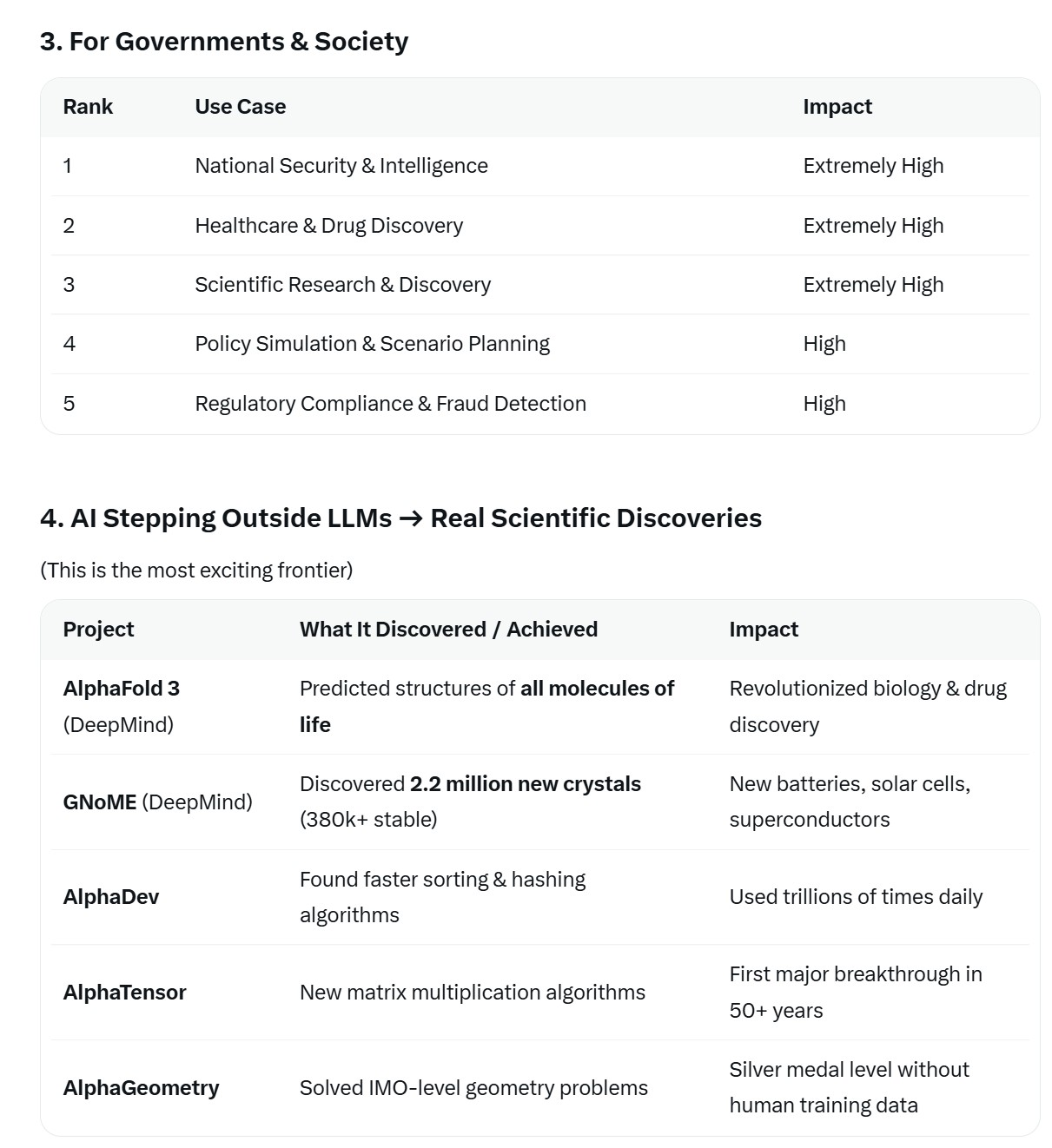
These projects prove AI is no longer just predicting text — it is now generating genuinely new scientific knowledge that humans could not discover on their own in reasonable time.
Bottom Line
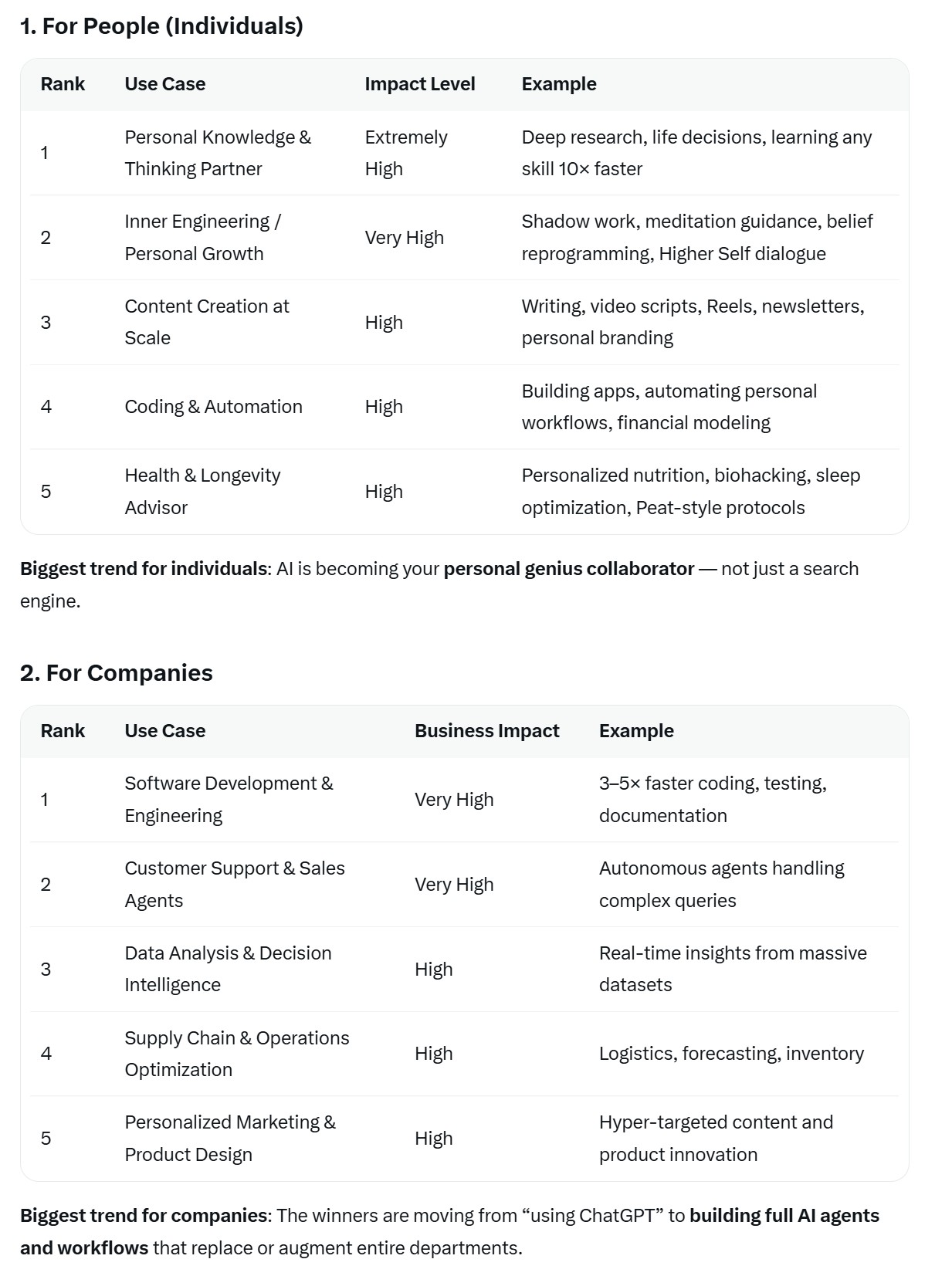
- For individuals: The biggest wins are in thinking, learning, and personal evolution.
- For companies: The winners are building real AI agents and workflows, not just using chatbots.
- For governments & science: The most transformative use is AI as a discovery engine (AlphaFold-level breakthroughs).
Personal use cases
Nothing I've tested comes close to Hermes.
It's the first AI agent that feels like a real mini employee living on my desktop.
It's powerful, but most people are barely scratching the surface of what it can do.
Here are some extremely high ROI Hermes agent use cases to get the most out of your AI:
=Personal OS dashboard: Use Hermes to vibe-code a personal operating system app (stores all your important data in one place - to-do list, calendar, etc.)
=Multi-agent coordinations: Tell Hermes "Launch multiple sub-agents for [x] task." Hermes then deploys multiple agents for research, coding, debugging, or whatever the task is.
=Personalised tutor: Have Hermes act as your tutor who builds interactive courses, guides, and resources for learning new skills
=Personal X assistant: With the latest X update, you can now plug Hermes directly into your accounts to scan bookmarks, read articles, and so on
=Knowledge base builder: Sits in your Slack/Notion, learns from team conversations, and auto-populates your internal wiki
=Job hunter: Give Hermes your CV + resume, and let it find high-paying job opportunities
These are all complete game-changers.
-Miles Deutcher