
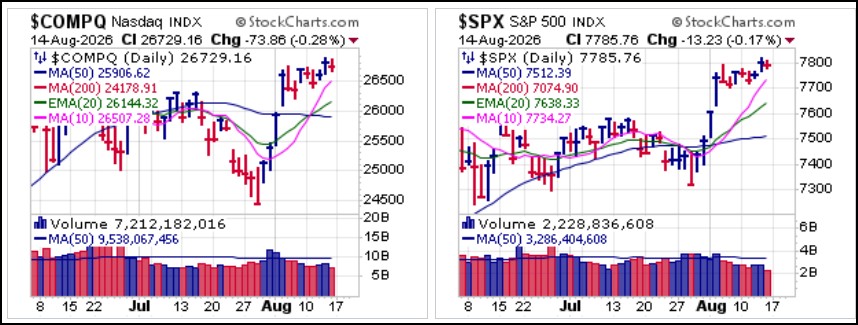
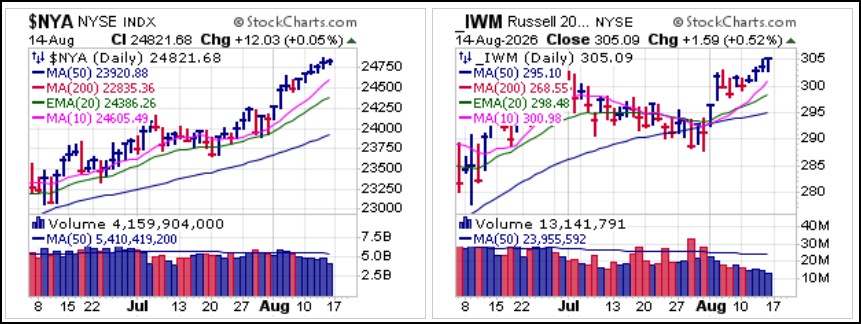
 The broader NYSE Composite and small-cap Russell 2000 Indexes both posted new all-time closing highs on Friday. Overall, major market indexes remain in uptrends as volume continues to diminish. Underneath the surface, however, the situation with individual stocks remains mixed.
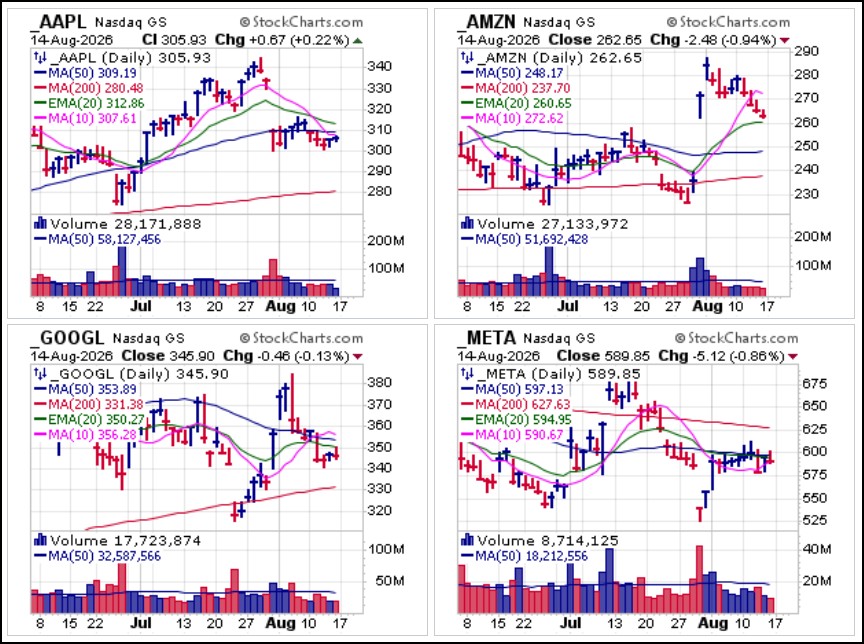
 For example, big-stock techs have not shared the indexes' upside enthusiasm. Apple (AAPL) has most recently be a short at 50-dma resistance while Amazon.com (AMZN) triggered a double-top short-sale entry 278.56 left-side peak of May 5th off to the left of the chart below. It triggered a second short entry at the 10-dma on Wednesday. Alphabet (GOOGL) triggered a double-top entry eight days ago on the chart below on a big outside reversal and then this past Wednesday triggered a short entry at the 50-dma. Both AMZN and GOOGL reported strong earnings in late July but in both cases the bulk of the revenues reported were from gains on private investment valuations. GOOGL's booked gains of roughly $77 billion after tax from Anthropic and SpaceX (SPCX), the majority of its $112 billion net income, while AMZN booked approximately $53.4 billion pre-tax, primarily from Anthropic, the bulk of its $62.6 billion net income. Finally, Meta Platforms (META), which we discussed a U&R long entry back in late July is hanging along 50-dma resistance without any decisive resolution either way. On Friday it acted like a short at the line so remains a fluid situation with bearish resistance along the 50-day line.
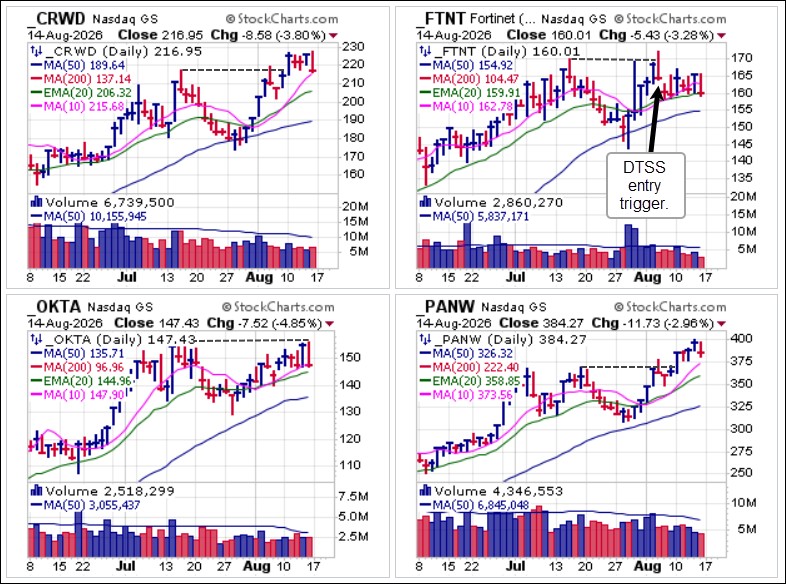
 Big-stock cybersecurity names, which we first reported on in early May as they gapped out of long bases, have continued to hold up near their highs. Thursday's index breakouts did not leader to any decisive upside, however, as CrowdStrike (CRWD), Fortinet (FTNT), Okta (OKTA) and Palo Alto Networks (PANW) all sold off. Technically, CRWD and PANW broke out earlier this past week such that pullbacks to 10-dma support and the prior breakout points (dotted lines) could be buyable. FTNT and OKTA remain in bases after reversing at or near left-side peaks (dotted lines). FTNT in fact triggered a double-top short-sale entry at the 170.35 July 15th left-side peak while on Friday OKTA reversed near its own July 15th left-side peak at 157.00.
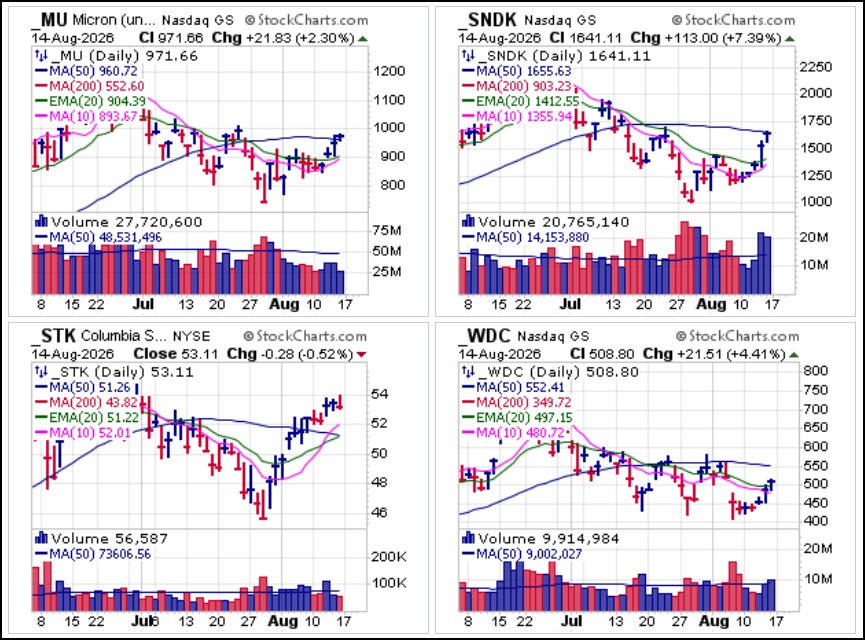
 Semiconductor memory makers were all boosted on Thursday as analysts from with price target raises from J.P. Morgan (JPM), RBC Capital, New Street Research and others issued buy recommendations and raised price targets for Micron Technology (MU) and SanDisk (SNDK) to $1,250 and $2,250, respectively. MU ended the week just above 50-dma resistance on light volume while SNDK closed just below 50-dma resistance on heavy volume. If both names can clear and hold their 50-dmas then they may be able to push higher, while any reversals at the line would trigger potential short-sale entries Seagate Technology (STK) and Western Digital (WDC) both rallied in sympathy as big-stock memory names but are currently not in any long entry positions on their respective charts.
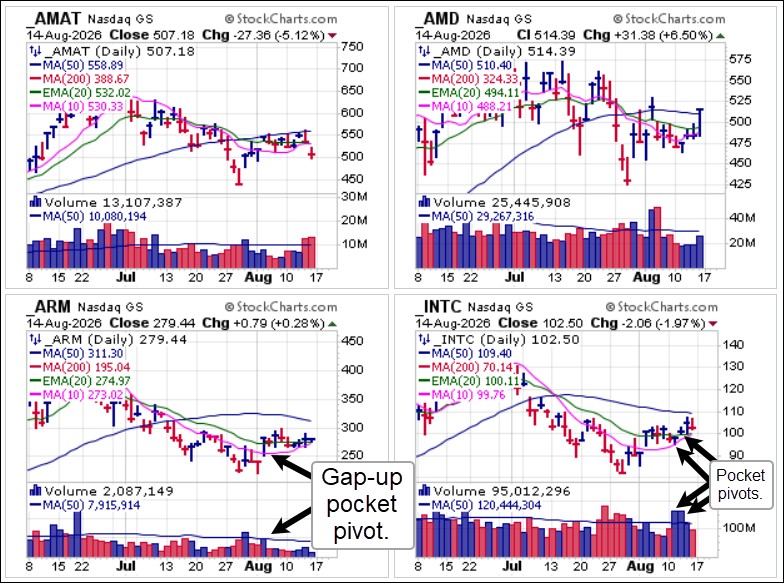
 Semiconductor equipment makers came under some pressure on Friday after Applied Materials (AMAT) reported disappointing earnings Thursday after the close, leading to a gap-down break through 20-dema support on Friday. Advanced Micro Devices (AMD) cleared its 50-dma. Allegedly, research firm Bernstein had raised their price target for AMD to $650 on Thursday. It is typical for bear rallies within correction phases and downtrends to be driven by analyst upgrades so much of this is not surprising and it is likely that we can expect more such activity as we move through the end of summer. Other semis we have reported on since the market turned back in early April, Arm Holdings (ARM) and Intel (INTC) both remain in flag formations after rallying off the lows two weeks ago. Two weeks ago ARM posted a gap-up pocket pivot (GUPP) long entry and has since tracked tight sideways along its 10-dma and 20-dema on various VDU volume signatures, while INTC on Tuesday and Wednesday of this past week posted pocket pivots at the 10-dma and then the 20-dema before running into 50-dma resistance on Friday and backing off slightly. Based on recent action as described, both ARM and INTC may be actionable as longs on pullbacks to 10-dma/20-dema support.
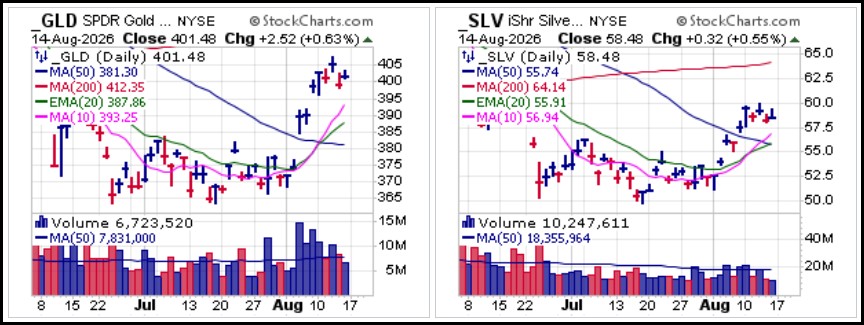
 Gold and Silver spent the week consolidating their sharp gains off the lows of two weeks ago as both metals now sit above 50-dma support. Both are extended from any long entry positions currently but we would watch for constructive pullbacks to 10-dma support as potentially opportunistic long entry points.
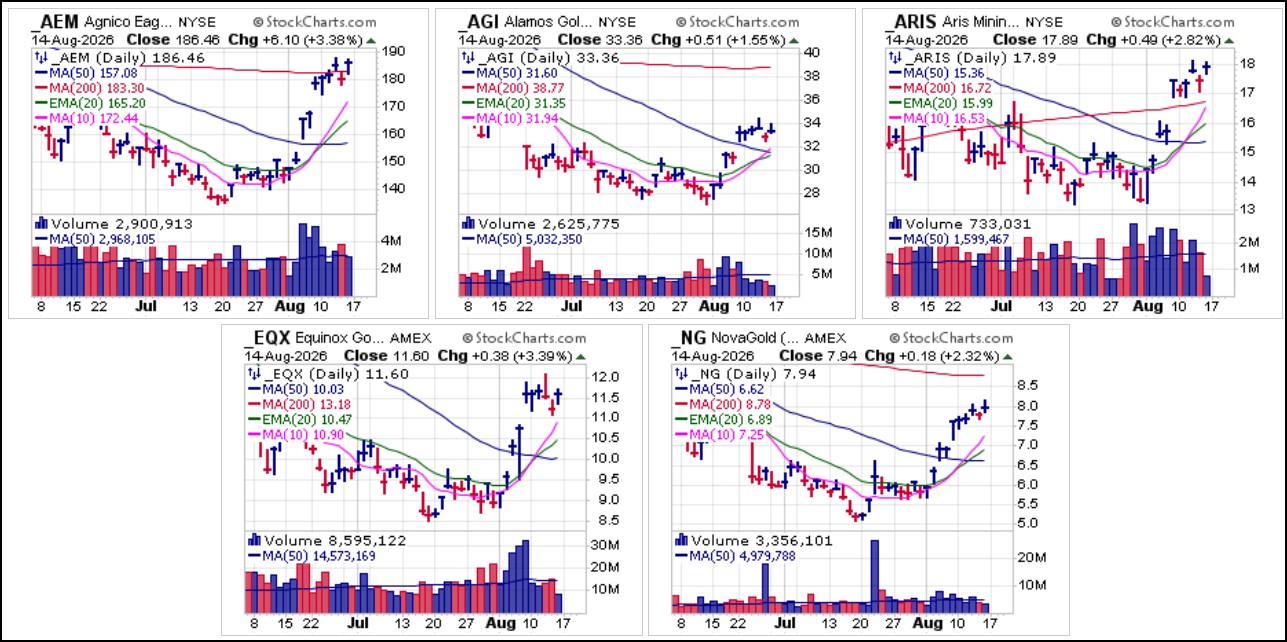
 Gold miners that we reported on the prior week spent this past week doing the same thing, consolidating sharp gains off the recent lows. As with the SPDR Gold Trust (GLD) and iShares Silver Trust (SLV), we would look for pullbacks to nearby moving average support as potentially opportunistic entries from here.
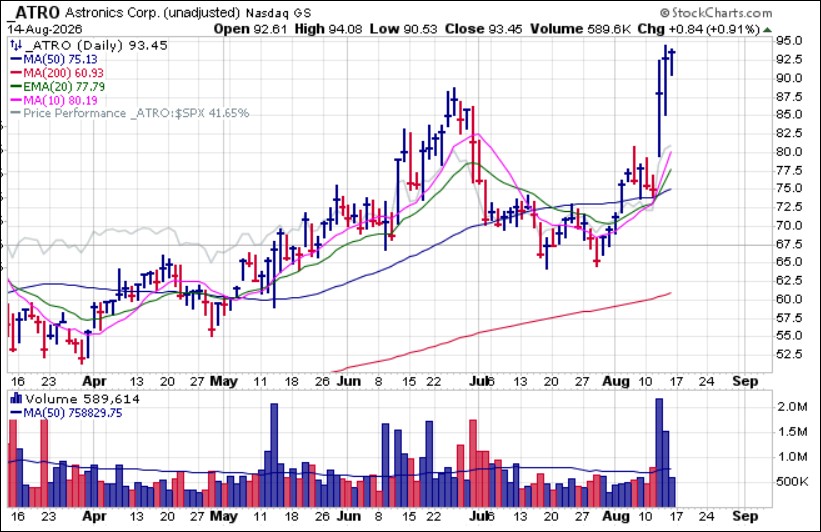
 On Wednesday we reported on aerospace/defense firm Astronics Corp. (ATRO) as a buyable gap-up (BGU) following its earnings report on Tuesday after the close. The stock has since moved higher and is now quite extended from buyable support so we might expect it to consolidate somewhere along current levels while the 10-dma attempts to play catch-up. Also watch the left-side peak in the pattern at 88.72 since a decisive reversal through that peak could also generate a DTSS short entry with the idea of catching a move back down to logical 10-dma support.
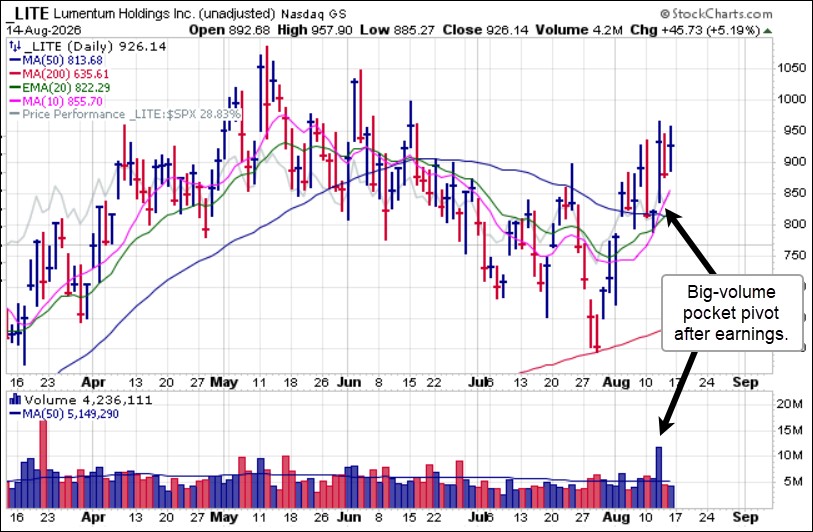
 On Wednesday we reported on Lumentum (LITE) as it posted a post-earnings pocket pivot that got extended rather quickly. On Thursday the stock pulled in, bringing it back into buying range of the pocket pivot before pushing back to Wednesday's highs. We would continue to view constructive pullbacks to the rising 10-dma as a potentially opportunistic long entries from here using the 10-day line as a tight selling guide.
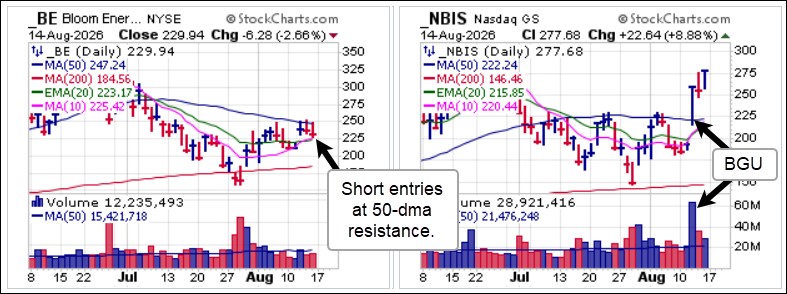
 On Wednesday we reported on AD Data Center Power/Infrastructure names Bloom Energy (BE) and Nebius Group (NBIS) as buyable gap-ups following a favorable earnings report from NBIS the day before. While NBIS' BGU worked out just fine and the stock ended the week at higher highs, BE morphed into a short-sale entry as it reversed along 50-dma resistance for three straight days. NBIS is now within 10% of the $300 Century Mark where it failed back on June 22nd when it hit a peak of 299.86 and then broke down over the next several weeks. It eventually bottomed at 145.80 on July 29th, a decline of 51.37% in just about four weeks. The stock has recovered sharply since the end of July but is now clearly extended and out of buying range for now following Wednesday's BGU.
 Major market indexes appear relatively benign as they steadily rise while underneath the surface we find that there are many ways to slice and dice individual stocks as they present various long and/or short-sale set-ups. Thus, we remain alert and flexible as things continue to evolve.
The Market Direction Model (MDM) remains on a BUY signal.