
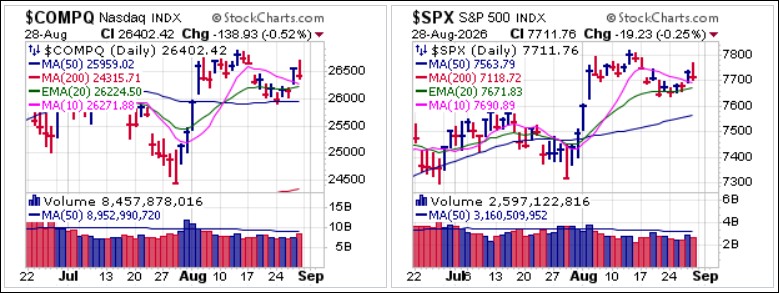
Warsh struck a hawkish enough tone that one might have thought he had already started to raise rates. He certainly talks the talk, but so far has done nothing material to address persistent inflation, e.g., walk the walk. Thus, his speech amounted to little more than political theater that was effective in its ability to turn the market southward.
It is interesting to note that while Trump was highly and aggressively critical of prior Fedhead Jerome Powell's reluctance to lower interest rates, he has given Warsh a free pass. While the speech was billed as the new Fedhead's most important speech so far, he failed to mention the $40 trillion national debt, the U.S. Treasury Department's increased long bond purchases in an attempt to suppress long Treasury yields, or the pathetic 1.5% Q2 2026 GDP Second Estimate announced on Wednesday. The question is whether Friday's reaction turns out to be a one-off as the market digests the reality of underlying conditions and calls Warsh's bluff.
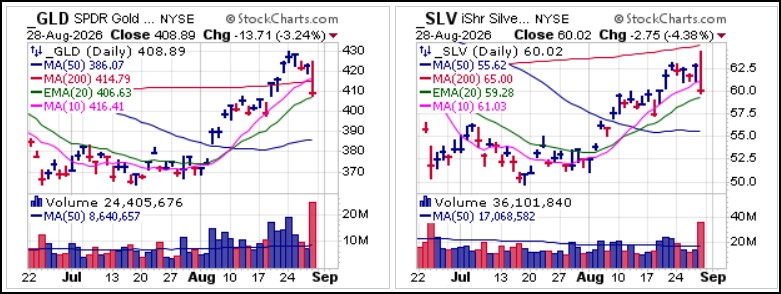
 Warsh's speech was also effective at sending gold and silver careening to the downside as the SPDR Gold Trust (GLD) and iShares Silver Trust (SLV) reversed at or around their 200-dmas. Within the context of the sharp, steep rallies in both during August, Warsh's speech may have been enough to spur profit-taking in what was becoming a hot money rally as both metals pushed to higher highs this past week. We tend to view 20-dema support as meaningful for both the GLD and SLV so this week will be something to be watched for this coming week as we roll into September.
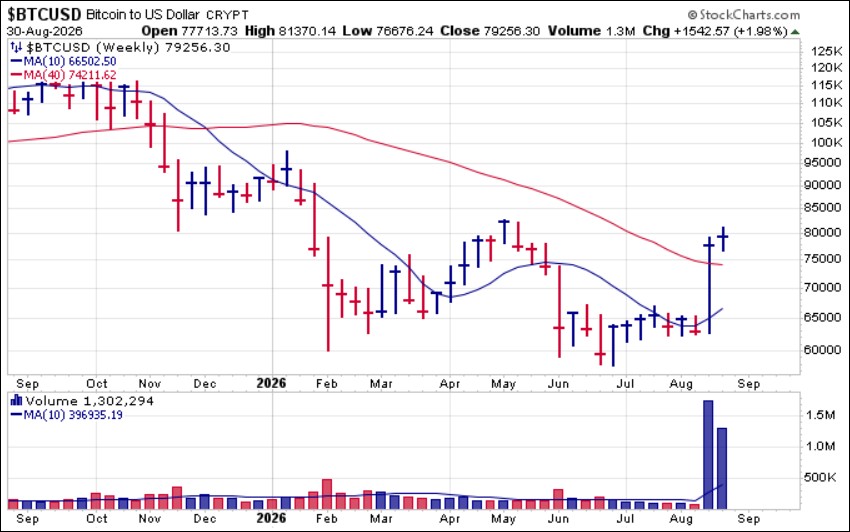
 Bitcoin ($BTCUSD) was also hit with selling on Friday but so far has held 10-dma support. Unlike the precious metals, $BTCUSD has only logged one strong upside week, so is less extended. It also more or less yawned at Warsh's hawkish talk on Friday as it ended the weekly slightly to the upside and held all of the prior week's gains. We see the 40-week/200-day moving averages as support levels where potential lower-risk entries might occur on any pullbacks from current levels.
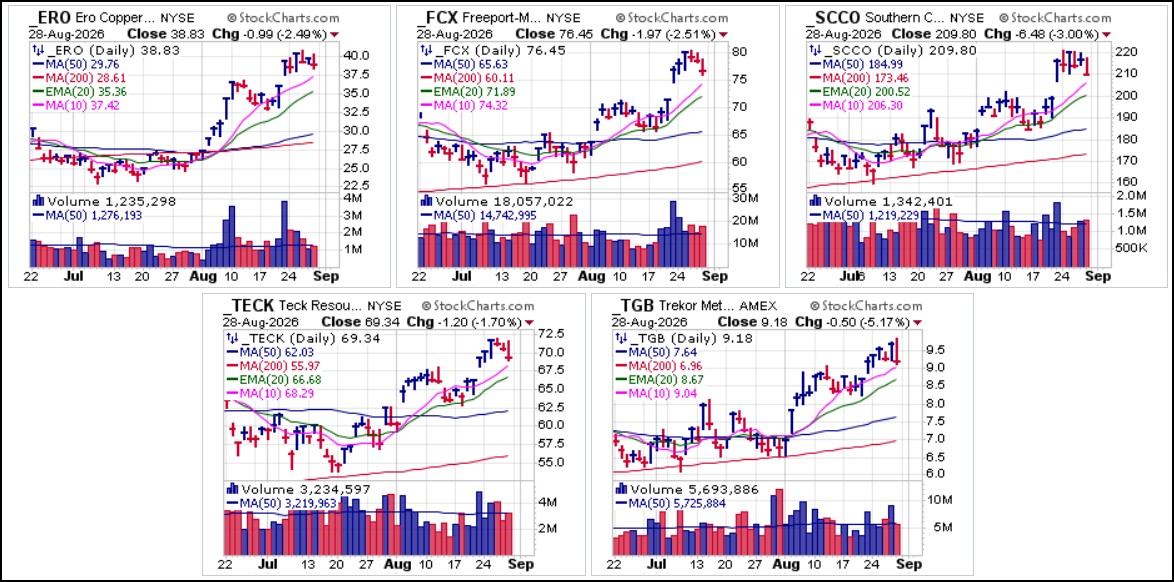
 Copper prices came in on Friday in response to Warsh's speech but copper still remains near its all-time high at 6.728, closing Friday at 6.54. Copper miners pulled back as well, but remain reasonably above 10-dma support. Both Freeport-McMoRan (FCX) and Trekor Metals (TGB) ended the week at all-time highs after breaking out two Fridays ago as the grouped gapped higher that day. Pullbacks to the 10-dma in all of these names should be watched for as potential lower-risk entries. Pullbacks to the 10-dma/20-dema in FCX and TGB would also roughly bring them back to the tops of their prior bases.
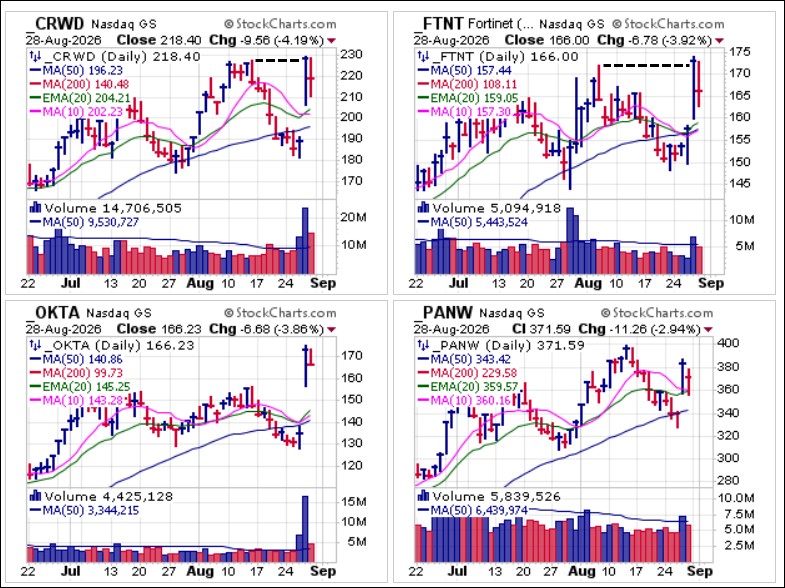
 Otherwise, softwares have led the tech side of the market equation as semiconductors continue to lag. Cybersecurity software names rallied sharply on Thursday in sympathy to earnings from CrowdStrike (CRWD) and Okta (OKTA), but on Friday we saw double-top reversals in CRWD and Fortinet (FTNT) that triggered double-top short-sale (DTSS) entries (dotted lines). CRWD tested the Thursday BGU intraday low, where it could still remain buyable despite being shortable at the highs. OKTA held Thursday's buyable gap-up quite well on Friday but is extended from the lows of Thursday BGU price range while Palo Alto Networks (PANW) posted a supporting type of pocket pivot at its 10-dma and 20-dema so would remain buyable on pullbacks to the two moving averages.
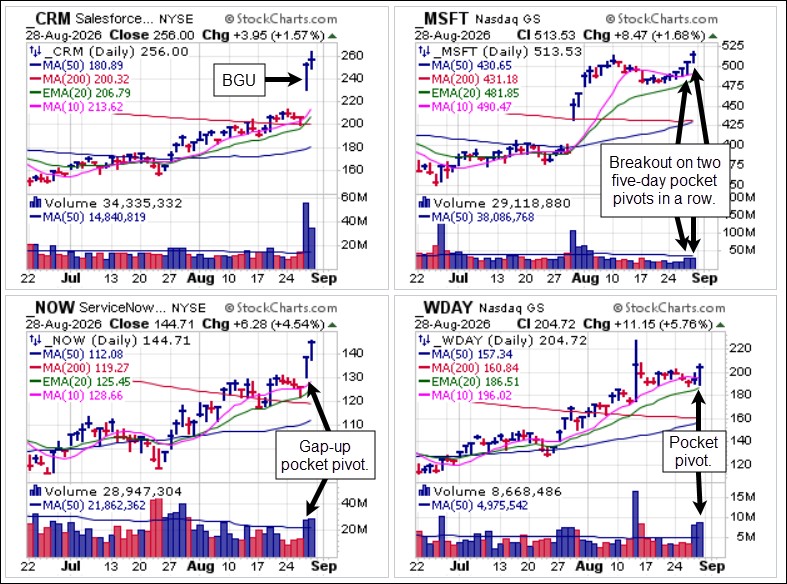
 Big-stock cloud software names have seen strong buying flows over the past two days following strong earnings from Salesforce.com (CRM) on Wednesday after the close and then Workday (WDAY) on Thursday after the close. CRM posted a BGU on Thursday while WDAY initially sold off Friday morning but then reversed off 20-dema support and closed above the 10-dma to post a strong-volume pocket pivot that is buyable using the 10-dma as a tight selling guide. Microsoft (MSFT) broke out on Friday on its second five-day pocket pivot in a row while ServiceNow (NOW) rallied on both Thursday, where it posted a gap-up pocket pivot (GUPP) in sympathy to CRM earnings and then continued higher, likely in sympathy to WDAY earnings the next day.
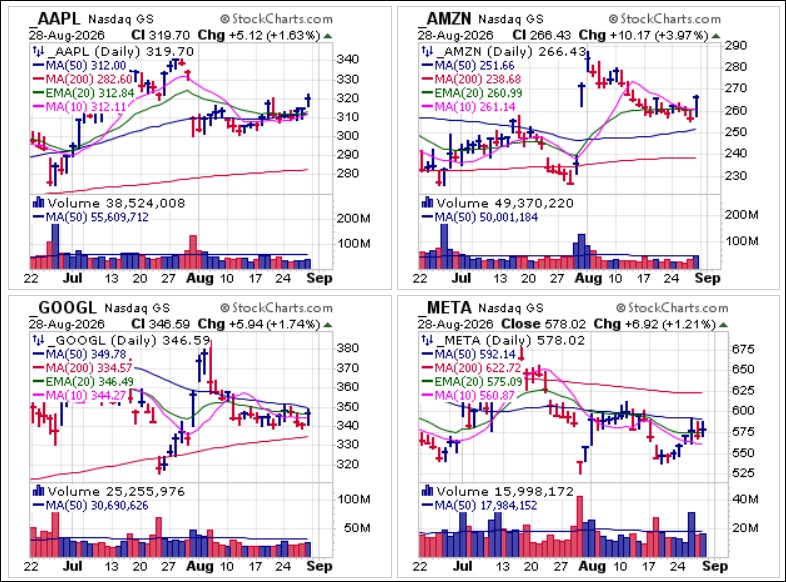
 We also saw money flowing into big-stock NASDAQ names Apple (AAPL), Amazon.com (AMZN) and Alphabet (GOOGL) on Friday. AAPL continues to rally on light volume likely in anticipation of its new foldable iPhone. AMZN posted a clean pocket pivot as it pushed back up through its 10-dma and 20-dema on Friday while GOOGL posted a pocket pivot along the same moving averages but remains below 50-dma resistance. If it can clear the line as AMZN did, then further upside might be in store. Finally, while Meta Platforms (META) has closed up two of the past three days, it has remained a short-sale at 50-dma resistance over all three days.
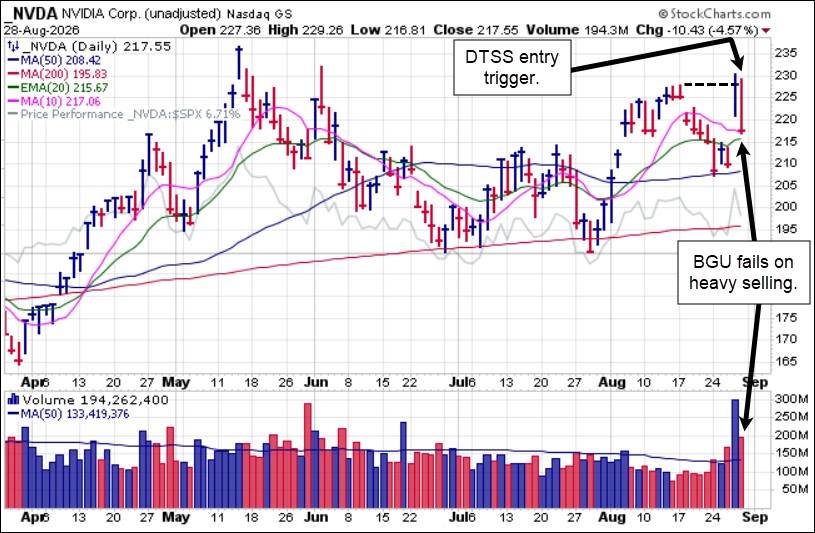
  Nvidia (NVDA) failed to inspire the semiconductor space after reporting earnings on Wednesday. An initial buyable gap-up (BGU) move failed quickly on Friday. That in face triggered a double-top short-sale (DTSS) entry at the prior high of two weeks ago before the stock streaked back down to the 10-dma and setting up the BGU failure. A break below the 10-dma from here would trigger another short-sale entry unless NVDA can hold and attempt to retake Thursday's BGU intraday low at 220.90.
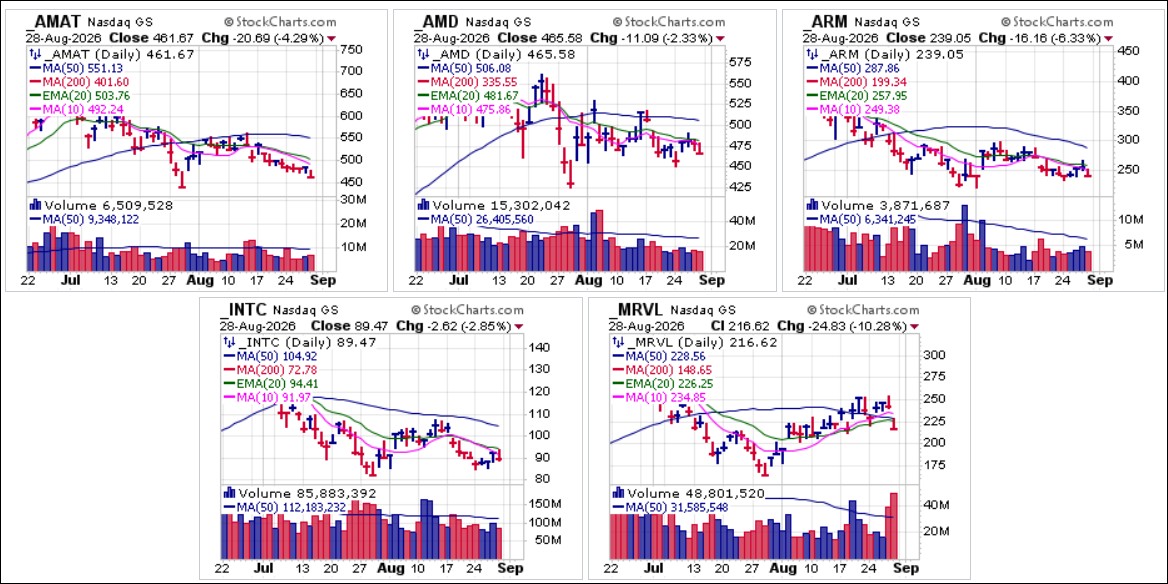
 Other semiconductor names we have reported on since April remained week. Here we see short-sale entry triggers in Advanced Micro Devices (AMD), Arm Holdings (ARM) and Intel (INTC) at 10-dma and 20-dema resistance on Friday. Marvell Technology (MRVL), which reported earnings on Thursday after the close, gapped down in response to trigger a short entry as it busted 50-dma support and continued to move lower before closing about half a percent above the intraday lows.
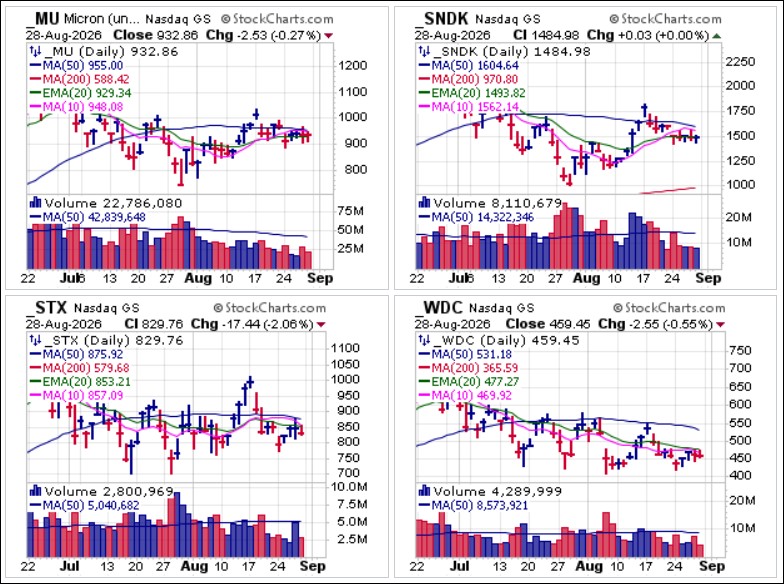
 Memory names also remained in a torpor. Micron Technology (MU) remains potentially shortable just below 50-dma resistance, while SanDisk (SNDK), Seagate Technology (STX) and Western Digital (WDC) are in short-sale positions along 10-dma/20-dema resistance.
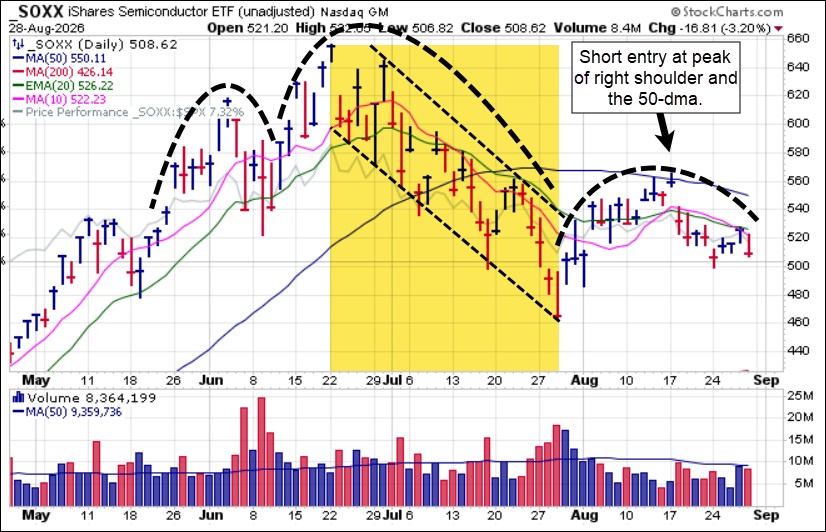
 The moves in precious metals, including copper, provided some strong upside juice and profit potential in August. That move may now need to consolidate as the end of summer looms. Meanwhile, semiconductors were a fertile field of short-sale profits in late June through the end of July, as the daily chart of the iShares Semiconductor (SOXX) ETF shows below. It may also be forming a right shoulder within a large potential head & shoulders formation where the late June through July sell-off formed the right side of the head in the pattern.
 This is a tricky market with stocks moving in both directions at various intervals. The Summer of 2026, however, has been marked by much uncertainty over Iran, the national debt finally clearing the $40 trillion level, a Fed that talks tough but fails to walk the walk of higher interest rates, a resurgence in alternative currencies and a slowing economy, but profit opportunities have been there if one is on the right side of the market in the right vehicle at the right time even without any persistent trends. As we end the summer and move into fall, which is typically a volatile season for the market, this may remain the case.
The Market Direction Model (MDM) remains on a BUY signal.