
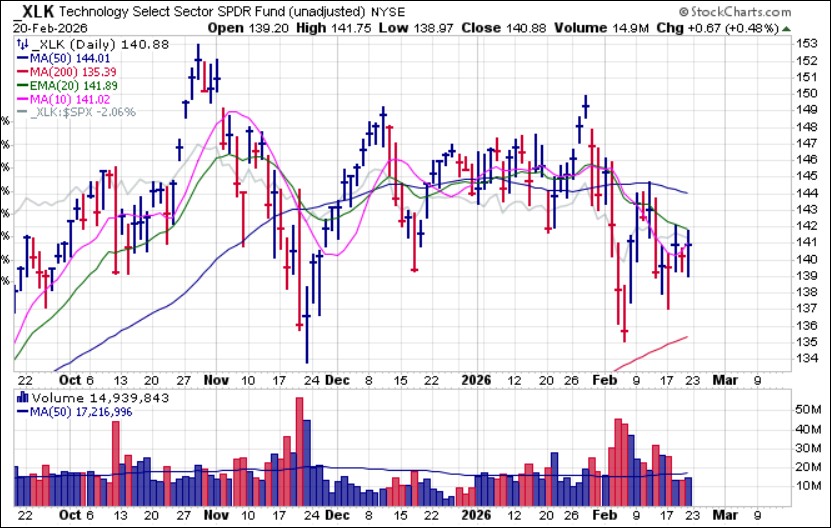
 Most big-stock techs reacted tepidly to the tariff news on Friday when one might have expected a more robust response. The SPDR Select Sector Technology (XLK) ETF shows a stalling rally into 20-dema resistance as it remains well below its 50-dma. For all practical purposes, this looks like a short-sale entry here using the 20-day as a covering guide. One could also employ an inverse tech-specific ETF as a vehicle for a short here with the idea of selling the inverse ETF if the XLK can meaningfully regain 20-dema resistance.
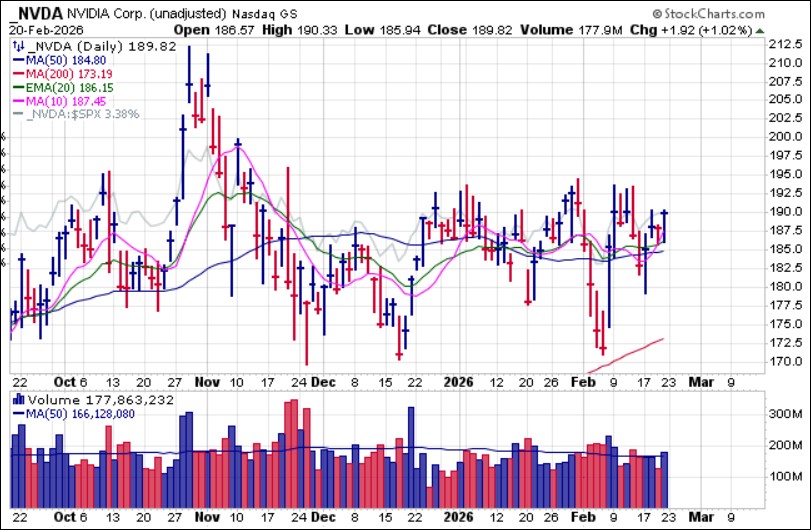
 Nvidia (NVDA), which would be a big beneficiary of tariffs disappearing given its major role as a supplier of AI chips to China, responded with a a miniscule 1.02% upside move on Friday. However, the company is expected to report earnings this Wednesday after the close, which could give the market some fodder with which to fuel some volatility in the AI tech space in either direction. Thus, NVDA earnings on Wednesday will be a key market event to monitor this week.
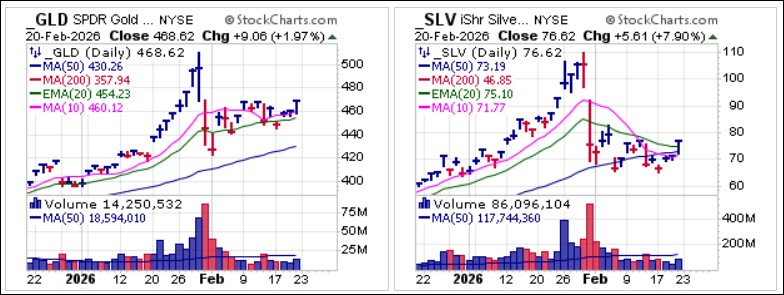
 Gold and silver initially sold off in reaction to the Supreme Court tariff decision, but quickly recovered back to the upside to post higher intraday highs by the close. Gold ended the day up 1.97% per the SPDR Gold Trust (GLD) with Comex Gold Futures finishing Friday at $5,130 an ounce. Fears that gold would be susceptible to further downside during the Chinese Lunar New Year have proven to be unfounded, so far. While gold ultimately responded bullishly to the tariff news it was silver that ripped higher. The iShares Silver Trust (SLV) posted a sharp 7.9% upside move as it cleared 20-dema resistance on Friday for the first time since selling down from a near-term climactic move in late January as sovereign and industrial buyers swarmed the market.
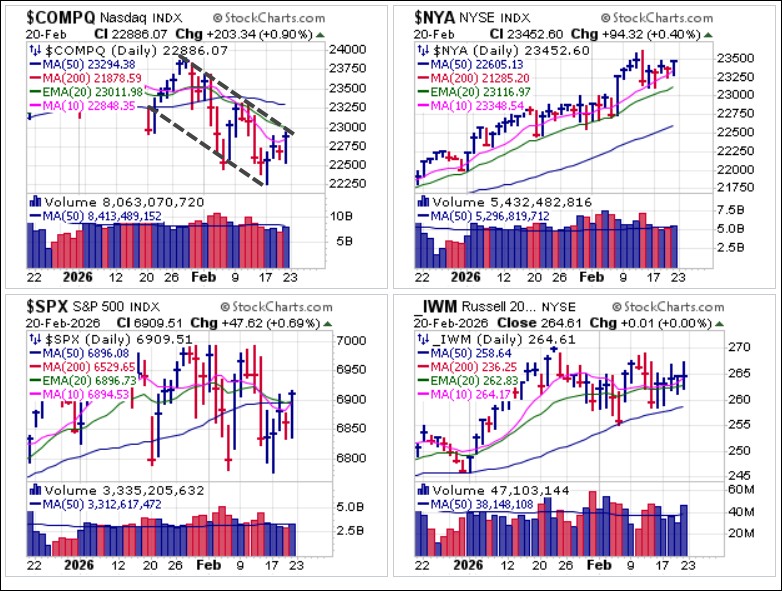
 This remains a difficult environment and we may see further volatility this week as the market sorts out and reacts to the latest tariff news now that Trump has declared his intention to work around or defy the Supreme Court one way or another. Indeed, on Friday Trump announced and signed a new 10% global tariff on almost all imports shortly after the ruling, using Section 122 of the Trade Act of 1974 (a different legal authority allowing temporary tariffs up to 15% for 150 days to address trade deficits). He later raised it to 15% on Saturday, February 21st, so this soap opera is not over just yet.
The current environment remains highly volatile, with markets poised for further swings this week as they digest the latest tariff developments. The Supreme Court's 6-3 ruling on February 20, 2026, struck down most of President Trump's sweeping tariffs imposed under the International Emergency Economic Powers Act (IEEPA), affirming that tariff authority primarily belongs to Congress.
U.S. futures are mixed to slightly down early this week, reflecting concerns over implementation, global retaliation, inflation pass-through, and supply-chain disruptions. Businesses and industry groups have hailed the ruling as a win for stability, but the new tariffs leave questions about $130–175 billion in potential refunds unresolved. The USTR is also launching Section 301 investigations for more targeted duties. Expect choppy trading, with tariff-sensitive stocks (e.g., importers, retailers) under pressure, while energy and defense may hold steady. Monitor Monday's open and any White House clarifications for direction.
The Market Direction Model (MDM) remains on a CASH/NEUTRAL signal.