
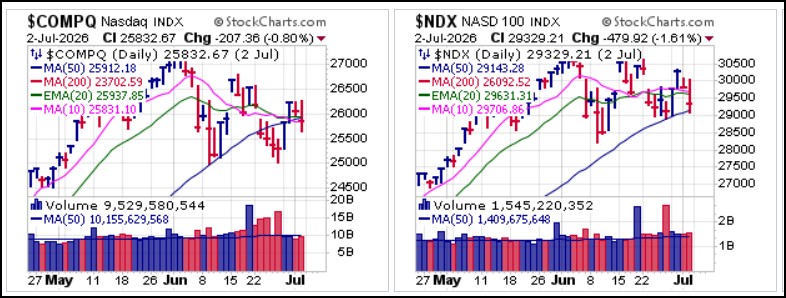
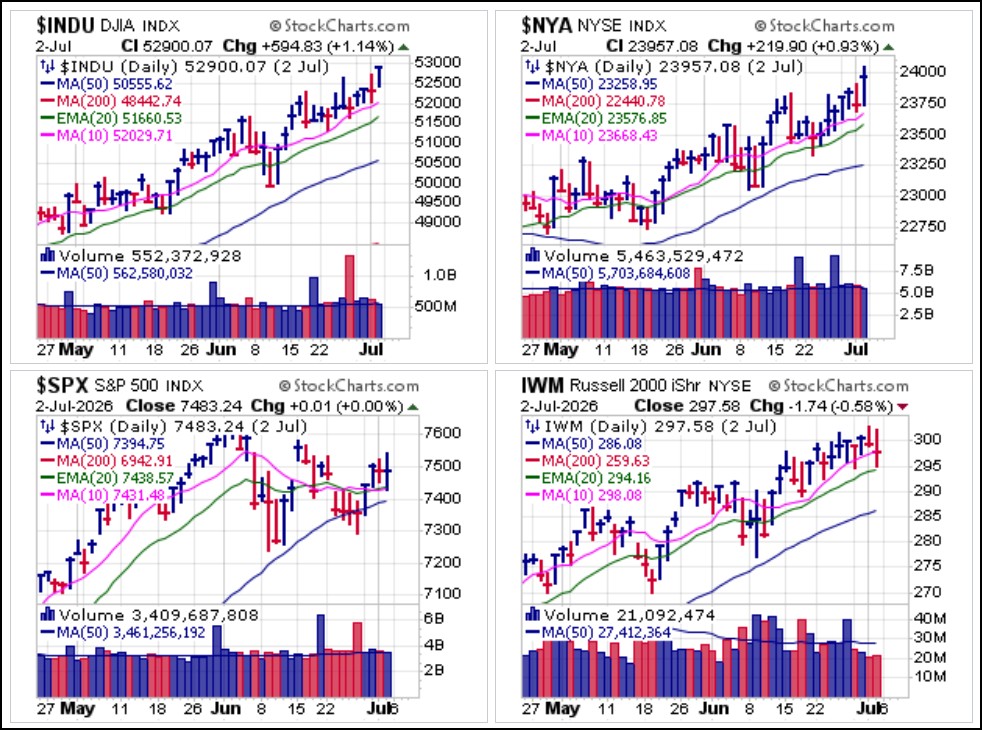
 Another aspect to the bi-polar nature of the week's market action was seen in the action of the less tech-centric indexes. Both the Dow Jones Industrials and NYSE Composite finished the week at all-time highs while the S&P 500 and small-cap Russell 2000 remain above 10-dma and/or 200-dema support. This of course reflects the fact that selling has been concentrated in the AI tech space where stocks are dropping like flies.
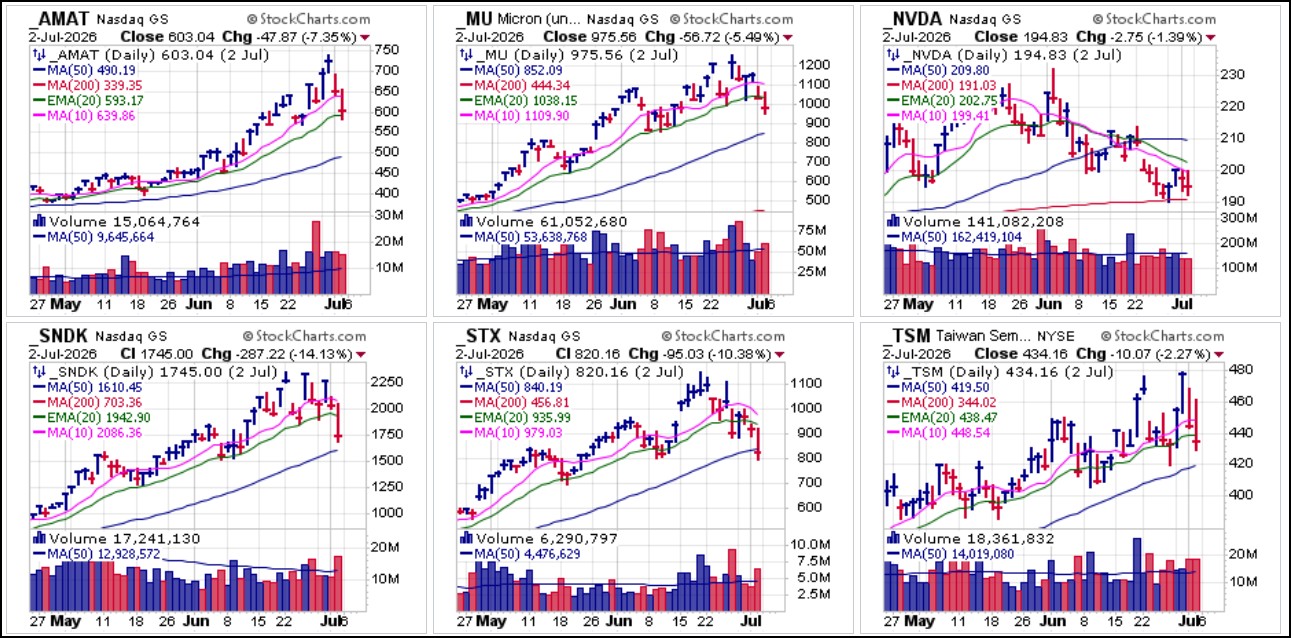
 Among big-stock AI semiconductors that we have reported on over the past 2-3 months, we can see sharp rallies into the end of the month that were then followed by sharp sell-offs in the first two days of July. Most striking are the reversals in Applied Materials (AMAT) and Taiwan Semiconductor (TSM) as they streaked to all-time highs at the start of the week before erasing all those gains and more by Thursday's close. We also saw Micron Technology (MU), SanDisk (SNDK) and Taiwan Semiconductor (TSM) trigger short-sale entries as they busted 20-dema support on Friday. Nvidia (NVDA) has already been a consistent and persistent laggard while Seagate Technology (STX) triggered a short entry as it dropped below the 20-dema on Wednesday before ending the week below the 50-day line where a second short-sale entry was triggered.
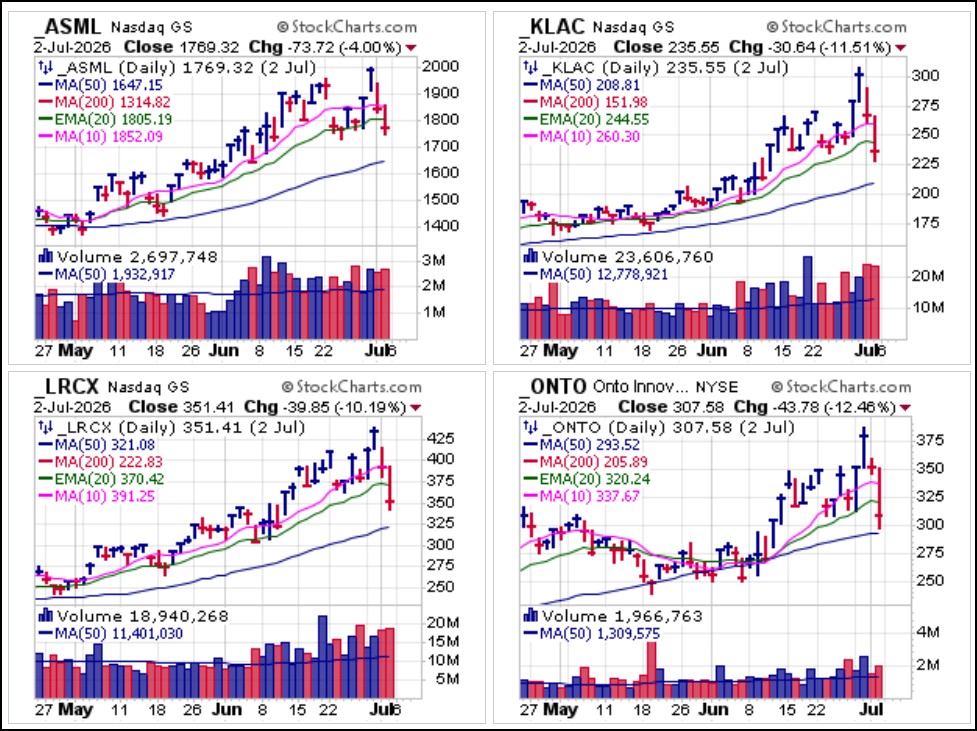
 The action in AMAT was duplicated in all of its other big-stock semiconductor equipment making cousins, with big price moves to new highs on Monday and Tuesday followed by the instant evaporation of those gains and my over the next two days. In each case short-sale entry triggers came into play as the stocks first broke 10-dma support as early as Wednesday before plummeting through 20-dema support on Thursday.
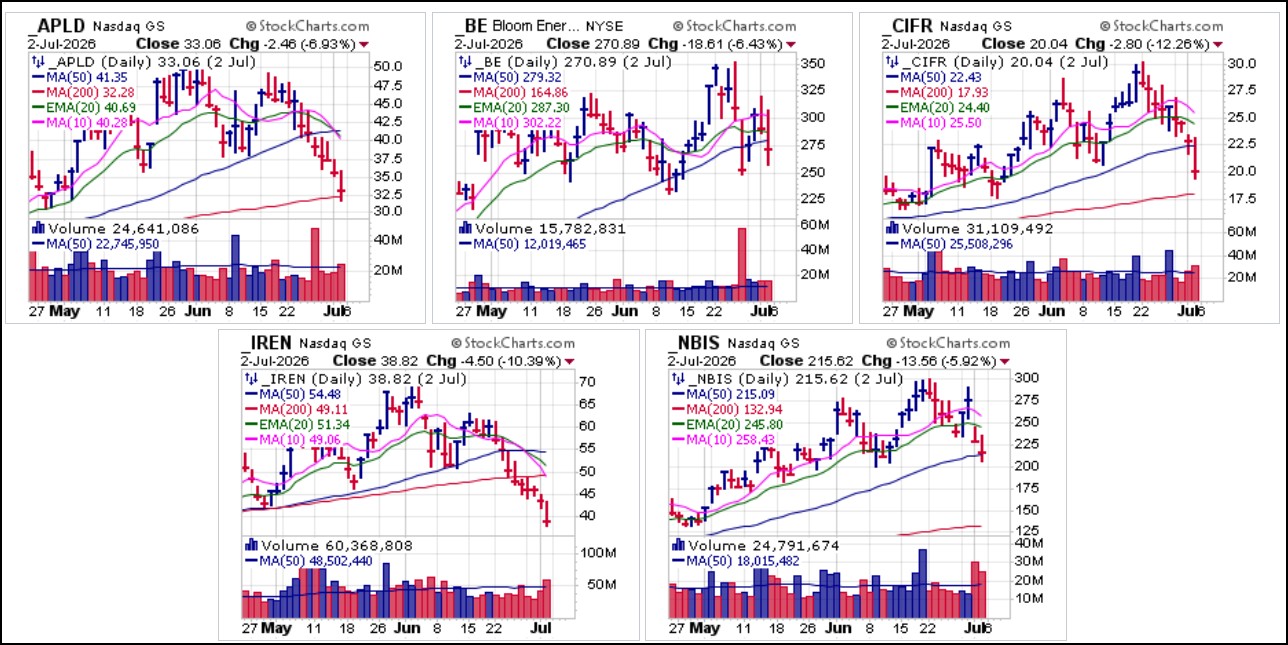
 While many are fixated on the narrative that AI is or is not in a bubble, which we, as objective chart-based traders/investors, find irrelevant, the reality is that several AI data center related names popped this past week, particularly previously strong performers like Applied Digital (APLD) and IREN Ltd. (IREN). Both stocks plummeted to lower lows this past week as APLD now tests its late May low while IREN slides into No Man's Land and well below its 200-dma.
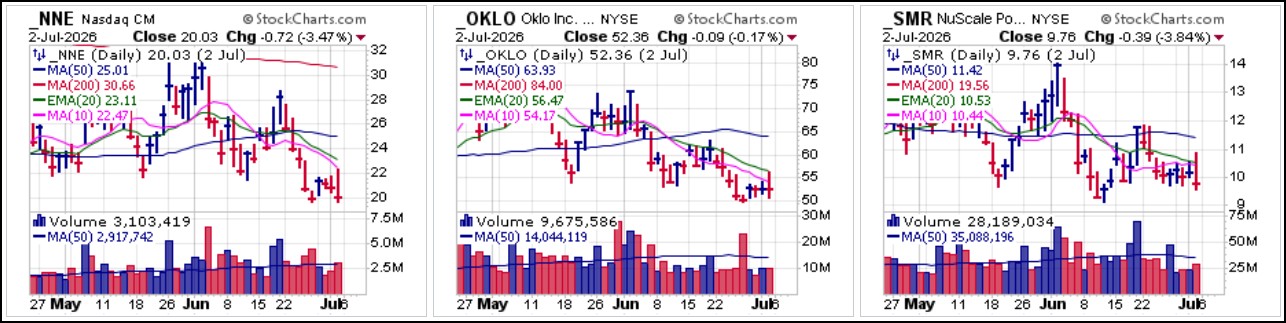
 The bubble has perhaps also popped for the small modular nuclear reactor makers which have been touted as developing localized nuclear power technology that will be able to meet the high energy demands of AI data centers. On Thursday all three of these names triggered short-sale entries as they reversed at or around 10-dma and/or 20-dema resistance.
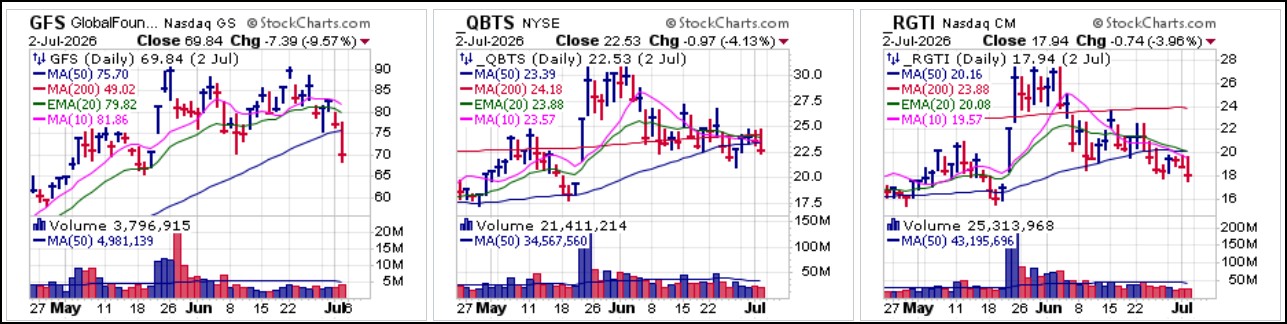
 Quantum computing names, which tend to act as a type of corollary to the whole AI thing, have also continued to come undone after mostly peak in late May. On Thursday we saw GlobalFoundries (GFS), which was previously attempting to form a new base, trigger a short-sale entry as it busted 50-dma support. D-Wave Quantum (QBTS) triggered a short at its 10-dma, 20-dema, 50-dma and 200-dma on Thursday all in one short, while Rigetti Computing (RGTI) reversed at 10-dma resistance as both it and the 20-dema have now crossed below the 50-dma.
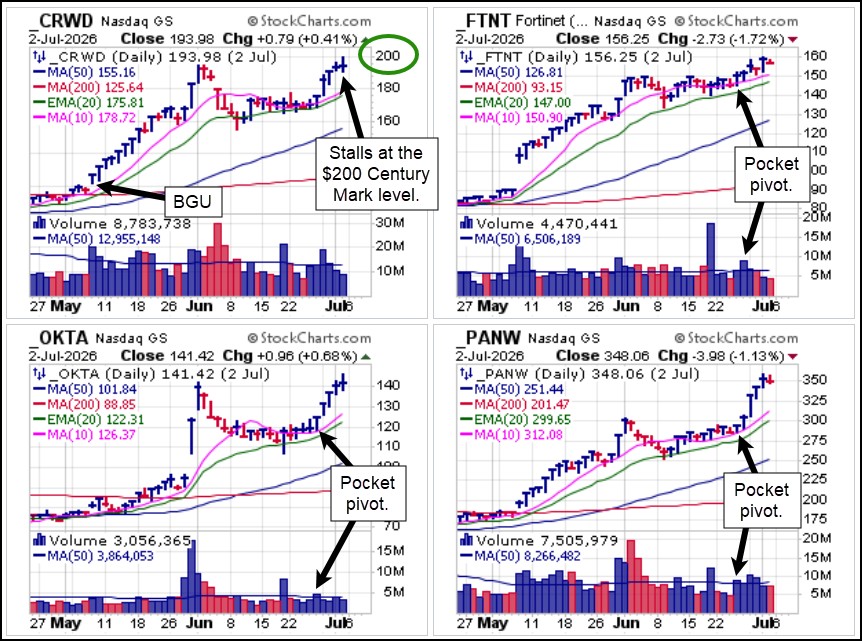
 Cybersecurity names, which are primarily software names, have been the stellar outperformers among big-stock techs heading into July following BGUs that we reported on back in early May. More recently these have all triggered pocket pivots last week, which we reported on at the time, and have since continue higher. CrowdStrike (CRWD) is interesting in that it stalled and reversed after coming within 47 cents of the $200 Century Mark. It simultaneously fell back below the 196.41 left-side peak in the base from June 1st before closing at 193.98, so technically triggering a double-top short-sale (DTS) entry there as well. We would also note that Okta (OKTA) reversed along the 142.35 left-side peak on Thursday after closing at 141.42. The reversal is marginal but still technically qualifies as a potential DTSS, although we would expect that in this position it could simply go about the business of building a handle around the current price level, as could CRWD. Stay tuned.
 Money continued to flow into beaten-down softwares, however, as it looked to lower-PE names as a refuge for cash exiting the semiconductor space. Meta Platforms (META) looked like another haven on Thursday as it gapped up on news that it was going to sell excess AI compute capacity to other firms, which the market initially took as a positive. However, this flies in the face of the idea that there is a shortage of AI compute capacity and investors reconsidered things on Thursday, sending META back through the 50-dma on Thursday.
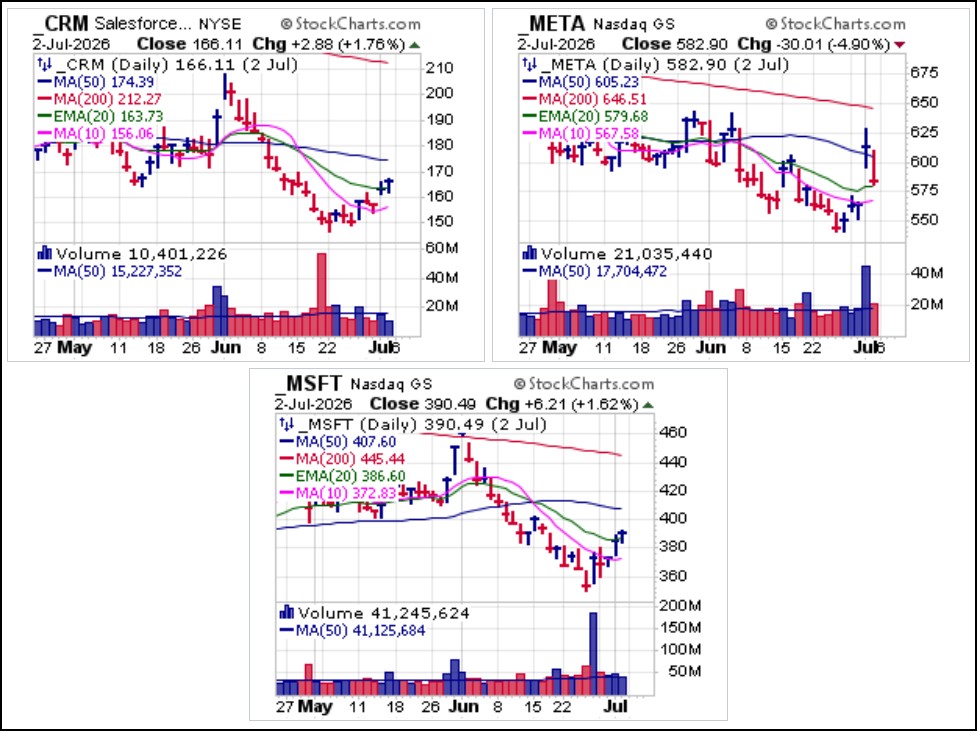 Clearly, the outperformance of less tech-centric indexes like the Dow, the NYSE Composite and the Russell 2000 this past week indicates that a shift is occurring. What is less clear, however, is whether that shift is a bullish rotation into underplayed, less overvalued areas of the market or simply a defensive rotation into cheaper stocks with more of a value connotation in anticipation of more trouble ahead for big-stock tech. Adding to the mix, futures rebounded overnight into Friday morning as the rest of the markets were closed. Only further evidence will add clarity, so we will report as necessary depending on how things play out from here as we move into H2 2026.
The Market Direction Model (MDM) remains on a BUY signal.