
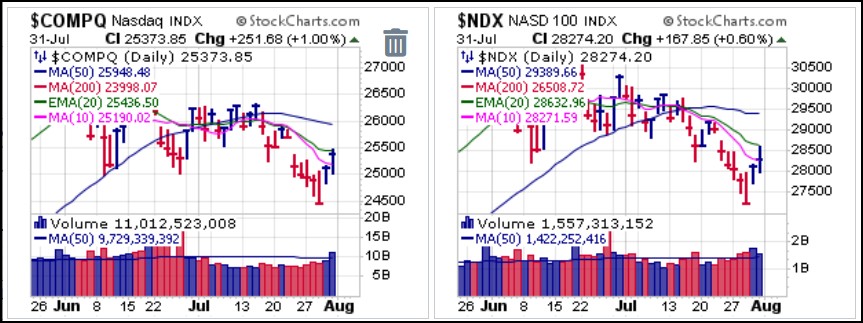
 On Thursday morning, the Wall Street Journal reported on the liquidation of Situational Awareness, a “once-highflying AI-focused hedge fund.” According to sources, the fund was levered 4-1 in big AI bets ranging from data center names like Applied Digital (APLD), Bloom Energy (BE), IREN Ltd. (IREN) to semiconductors like Micron Technology (MU) and SanDisk (SNDK), among others. For those who can do math, a 25% decline in an investment that is levered 4-1 wipes it out. The fund cashed out by selling most of its stock portfolio to Ken Griffin’s investment firm Citadel after its holdings were smashed, resulting in huge losses. Anecdotally speaking, this is classic bubble market stuff.
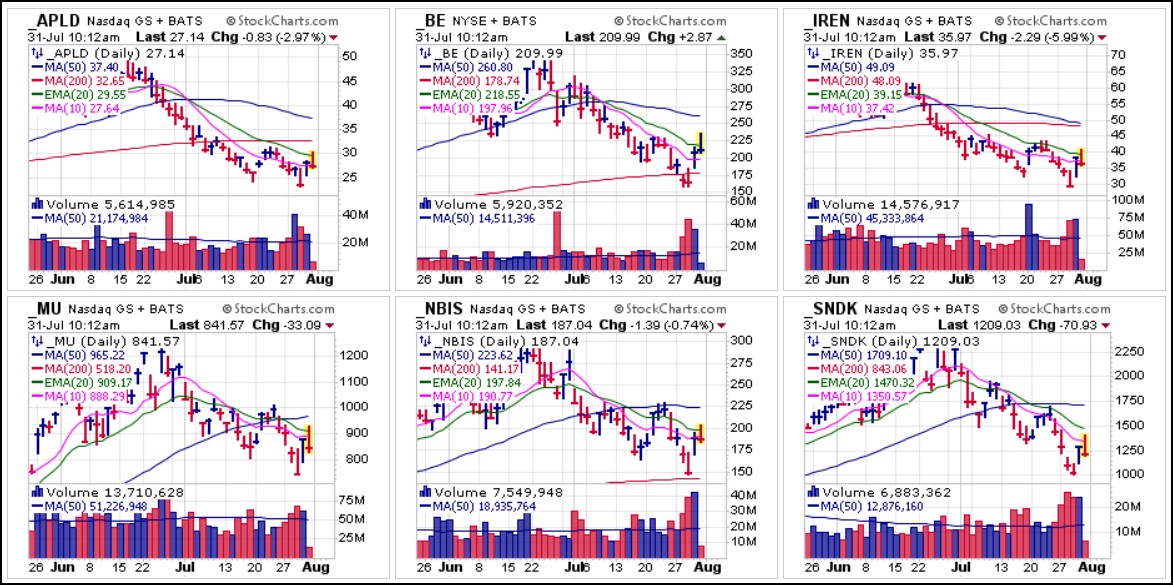
On a charting note, you can see that while these names all rallied on Thursday, sellers came back to hit them on Friday at moving average resistance. Thus we see APLD, BE, IREN, MU, and NBIS triggering short-sale entries as they reversed at 20-dema resistance while SNDK reversed at 10-dma resistance.
 The news of a big seller going six feet under created something of an upside vacuum on Thursday as shorts scrambled to cover once the Situational Awareness (a self-parodying name, no doubt!) hedge fund news came out. With the fund now liquidated, a near-term washout of forced selling was perceived by investors, leading to sharp rallies all around on Thursday.
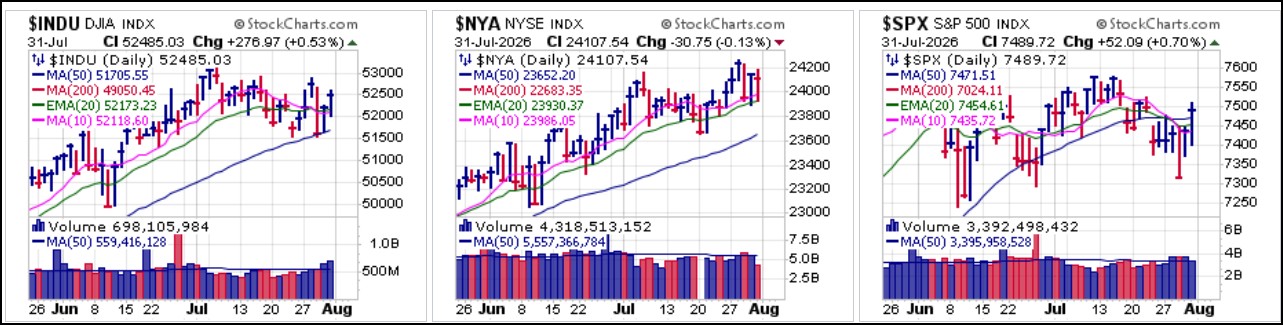
The NYSE-based Indexes, the Dow, NYSE Composite and S&P 500 all finished the week more or less where they started it. The Dow bounced off 50-dma support on Thursday and regained the 10-dma and 20-dema by the end of the week while the S&P 500 regained the 50-dma and the NYSE Composite yawned, pulling into 20-dema support on Thursday and Friday before rallying back to the highs of the day.
 Meanwhile, Nvidia (NVDA) CEO Jenson The Big Huanger Huang is running around assuring everyone that there is no AI bubble, most recently in an Axios interview two Fridays ago where he also repeated (whether intentionally or not) the now famous DotCom era style claim that "this time its different." Objectively, anyone paying attention would expect him to say anything else, and within the context of what we saw in the market this past week, Huang's comments two Fridays ago seem a bit absurd. While he has been quite successful as the CEO of NVDA, he seems to keep a side job as a notable AI hypester and promoter who loves to talk his book. His word is not gospel - the only truth is on the charts.
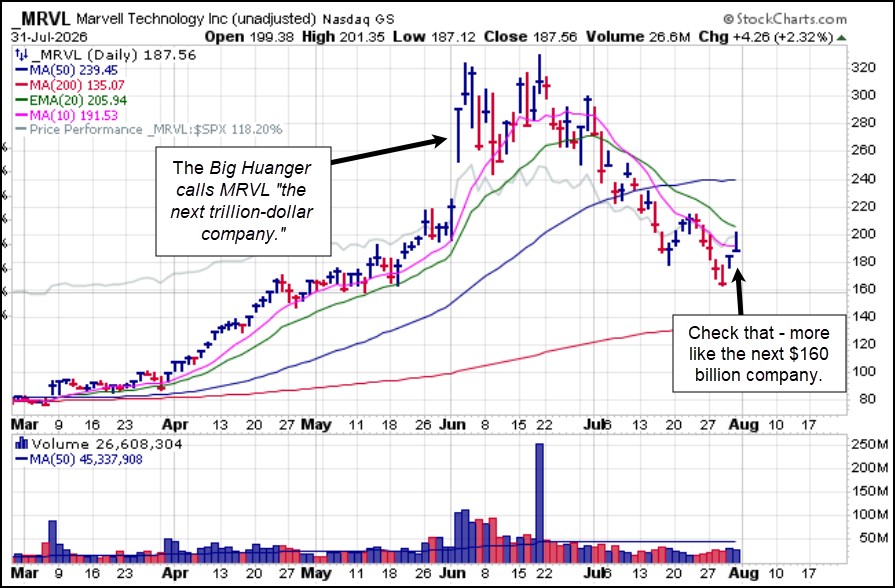
Consider that back on June 2nd he confidently touted big-stock semiconductor and AI-related tech Marvell Technology (MRVL) as the "next trillion dollar company." Of course, he was again talking his book, as the two companies had already announced a strategic partnership back on March 31st that included a $2 billion NVDA investment in MRVL. But, as it turned out, MRVL quickly topped and declined a brutal 50%-plus in six weeks and about eight weeks since Huang's pump, making it merely the next $160 billion company as of Friday's close. The action in late May and early June is a fantastic example of a climactic top with the stock up 8 out of 9 days in a row with the largest one-day price move coming on the day of Huang's pump. Classic.
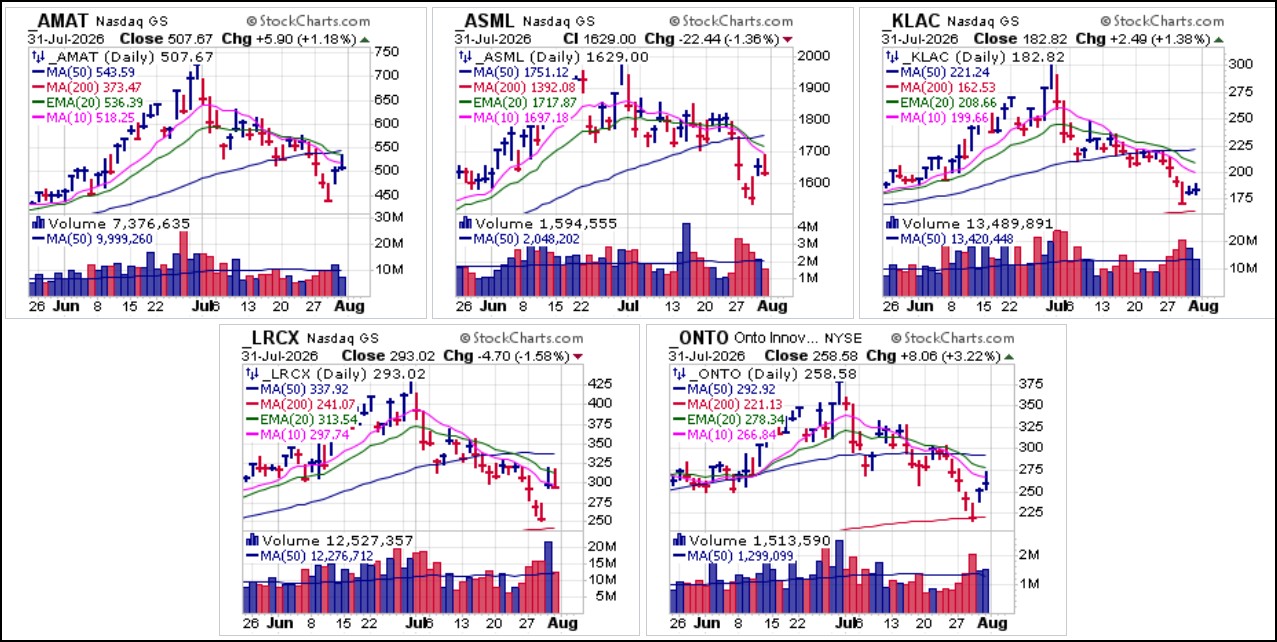
 To some extent, Huang's book-talking pumps are also the anecdotal stuff that market bubbles are made of. Despite Thursday's strong market bounce, tail-up style reversals and stall outs plagued the AI semiconductors and other related big-stock techs on Friday. Some further examples are seen in names like the semiconductor equipment makers for example, where we saw Applied Materials (AMAT), ASML Holdings (ASML), Lam Research (LRCX), and Onto Innovation (ONTO) all reversed at 10-dma and/or 20-dema resistance to trigger short entries early in the day.
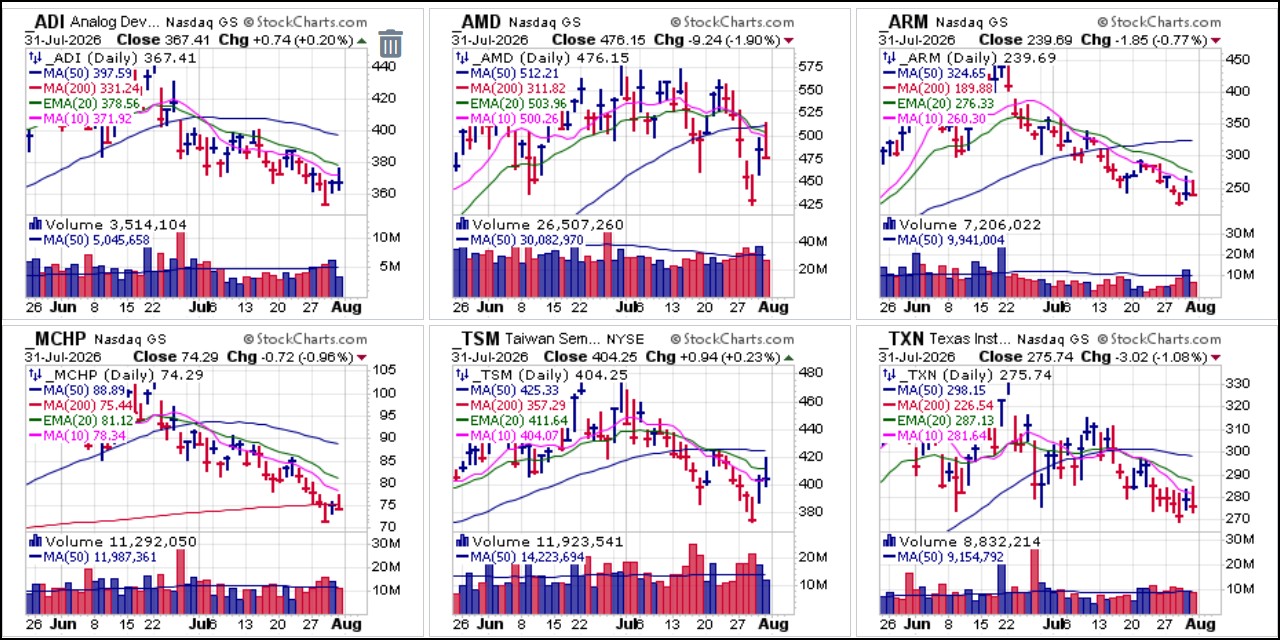
 Other examples of semiconductors going tail up on Friday at moving average resistance are shown below, and suffice it to say that you get the idea. The entire AI space remains weak as money managers took advantage of the two-day rally to unload shares at month-end. Reversals at the 20-dema in Analog Devices (ADI), Advanced Micro Devices (AMD) and Taiwan Semiconductor (TSM) were reasonable short-sale entry triggers on Friday, while Arm Holdings (ARM) and Texas Instruments (TXN) reversed along lower 10-dma resistance. Microchip Technology (MRVL) the dog among a very doggy lot here, reversed near the 10-dma but then triggered a short entry as it broke back below the 200-dma. There is currently little evidence with which to try and call any kind of low for most stocks aside from the two-day oversold rally we saw at week's end.
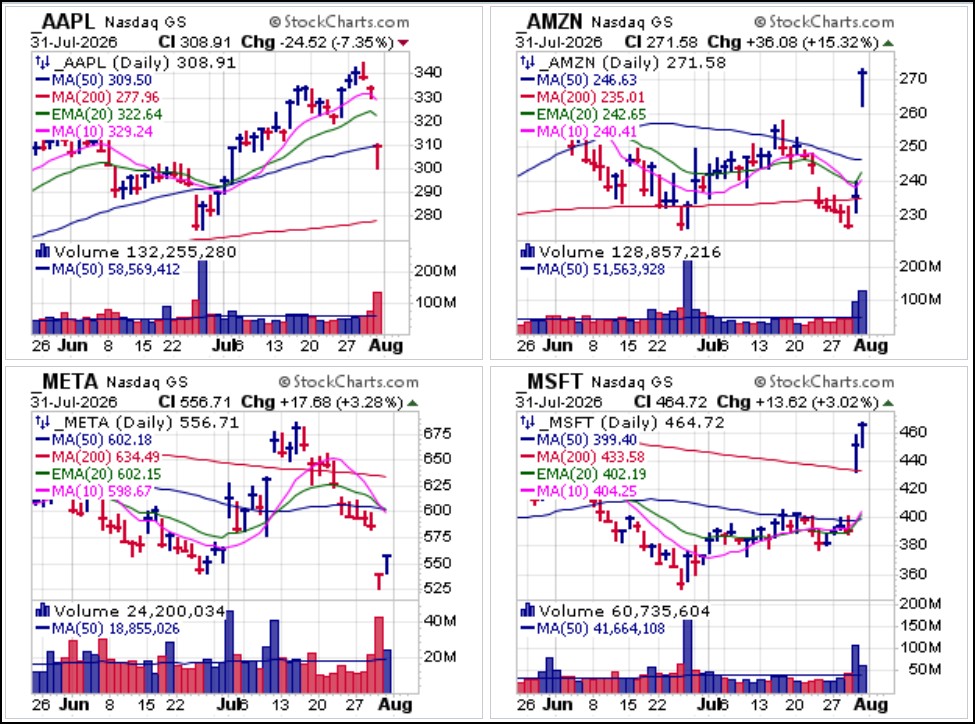
 While the market and most stocks are in need of a healing session, there were a couple of bright spots, as well as a couple of disasters among the four big-stock NASDAQ names that reported earnings this past week, Apple (AAPL), Amazon.com (AMZN), Meta Platforms (META) and Microsoft (MSFT). On the upside, AMZN and MSFT posted buyable gap-ups (BGUs) on Thursday and Wednesday, respectively while AAPL and META gapped lower after earnings on Thursday and Wednesday, respectively.
AAPL's gap-down break may work out more as a shortable gap-down (SGD) as it sits just below 50-dma resistance which can be used as a selling guide. It is also the first gap-down break off the peak. META, on the other hand, was already quite extended on the downside by the time Thursday's post-earnings gap-down disaster hit, so had an exhaustion gap feel to it. And, indeed, that is how it played out as META went on to post a U&R through the 540.18 June 25th low.
 At best, set-ups in the market are situational in nature as some are a function of earnings season, and we have just passed through the thickest point of that season, while others are mostly related to the technical action endemic to market and stock declines, essentially part of the pattern of price breaks and reaction bounces that then fail and result in lower lows. So far, that pattern has not been broken in most cases. Thus, on a trend-following basis, this is not a target-rich environment unless one has been targeting the short side in what has been the worst July for the NASDAQ in 22 years.
The Market Direction Model (MDM) remains on a SELL signal.