
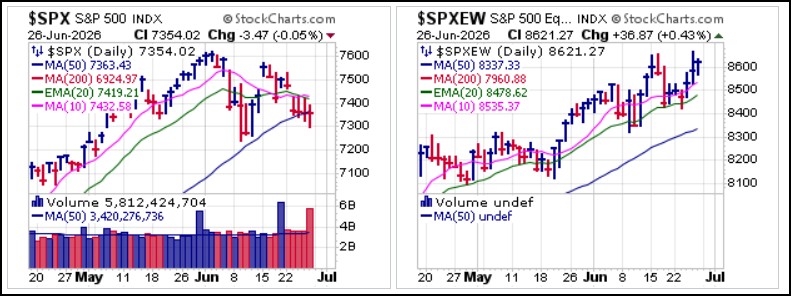
 The divergence in big-stock tech is also seen in comparing the S&P 500 Equal-Weighted Index to the S&P 500 itself, showing the deleterious effect that the higher concentration of highly-weighted technology stocks has on the $SPX vs. the $SPXEW. While the S&P 500 is now sitting below 50-dma resistance the S&P 500 Equal-Weighted Index made a new all-time closing high on Friday.
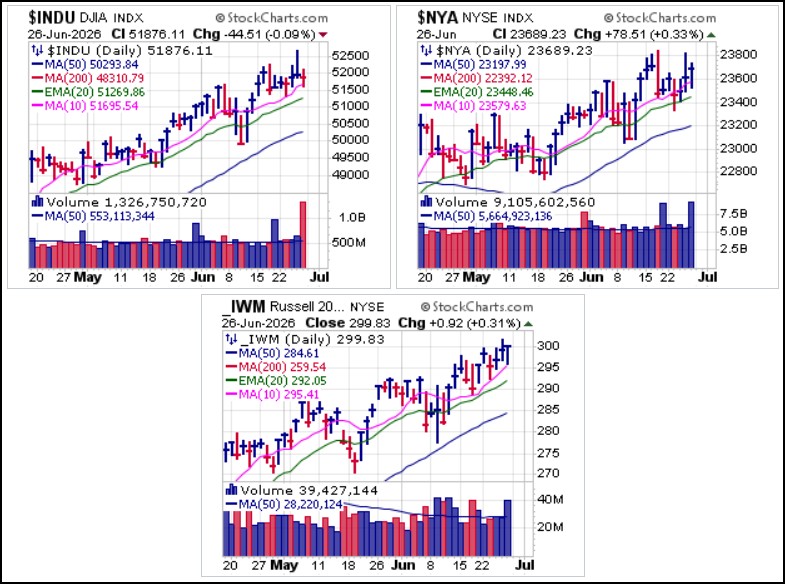
 The divergence becomes even more stark on an index basis as we see the less or entirely non-tech centric indexes hold up much better than their tech-centric siblings. The Dow continues to hold 10dma support while the NYSE Composite traded higher on Friday on big NYSE volume. The small-cap Russell 2000 Index as represented by the iShares Russell 2000 (IWM) ETF posted a new all-time closing high on Friday. Clearly, there is rotation out of tech and into other areas of the market, but the question remains whether this will play out as a constructive bullish rotation or merely a defensive rotation as money seeks out lower-PE and less overplayed and over-owned areas of market as it looks to shield itself against further market downside that would likely be led by the tech sector.
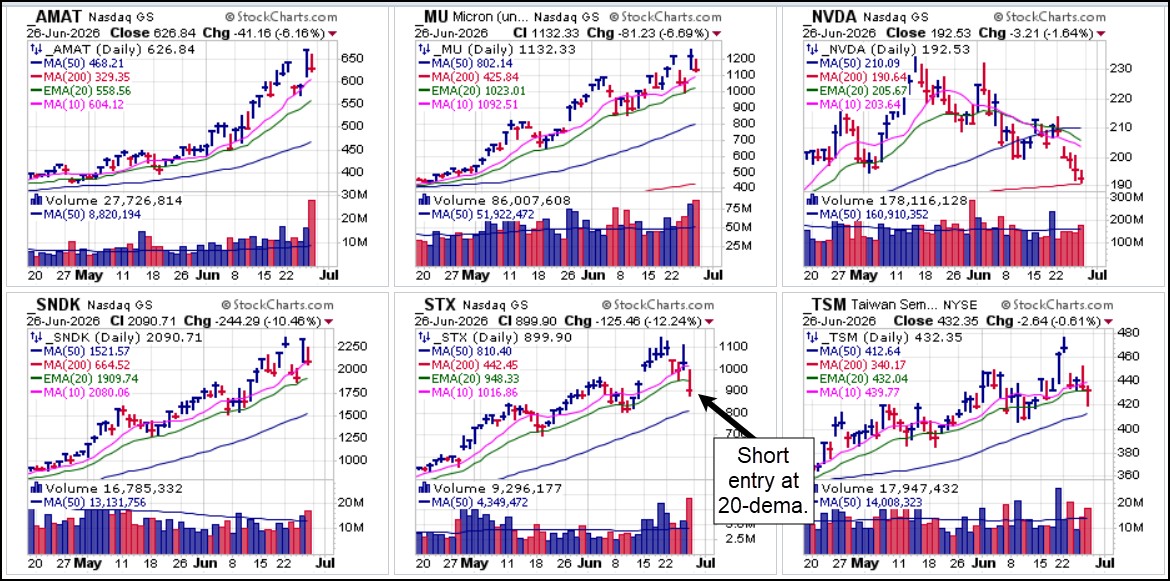
 Big-stock semiconductor names that we have reported on a various times during their uptrends since April all sold off hard on Friday on heavy volume. Micron Technology (MU), which looked like it would lead a mass semiconductor move to new highs after blowing out earnings on Wednesday posted an extended buyable gap-up (BGU) on Thursday but then failed to close below the Thursday BGU intraday low on Friday. Among these, Seagate Technology (STX) posted a short-sale entry first at its 10-dma on Friday morning before streaking through 20-dema support to trigger another short-sale entry at that point. Applied Materials (AMAT) and SanDisk (SNDK) both held above 10-dma support while Taiwan Semiconductor (TSM) broke below the 20-dema early on Friday before regaining the line by a mere 31 cents. A break back below the 20-day line would trigger a potential short-sale entry at that point so should be watched for. Nvidia (NVDA), once the darling of the AI FOMOnistas, remains a laggard after peaking in May and trending steadily lower as it now meets up with 200-dma support.
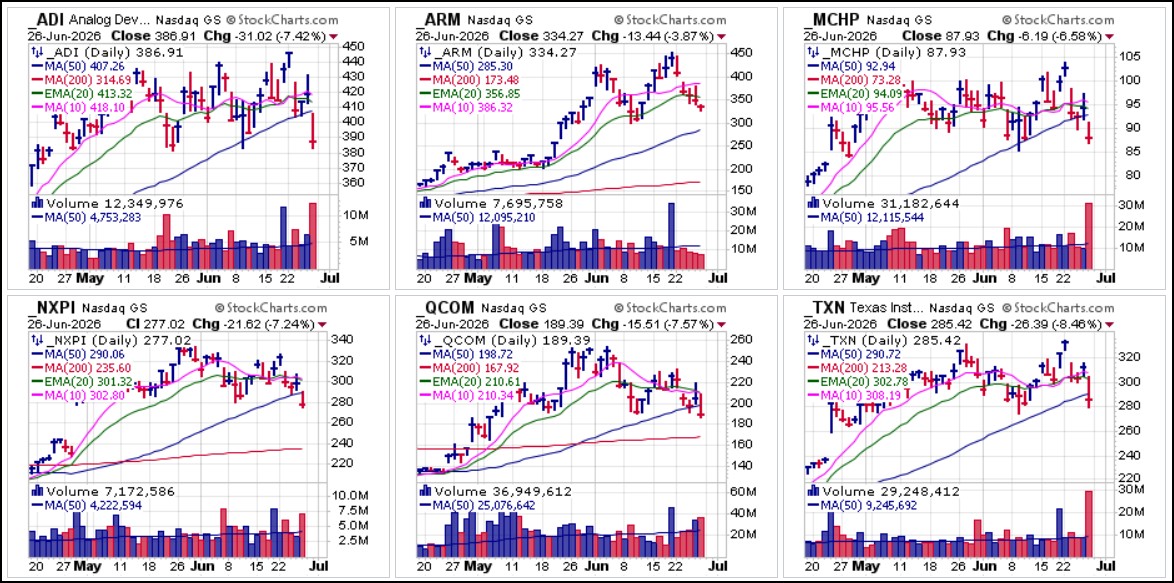
 Other semiconductors that triggered short-sale entries over the past two days are Analog Devices (ADI), Microchip Technology (MCHP), NXPI Semiconductors, Qualcomm (QCOM) and Texas Instruments (TXN), all of which triggered short-sale entries as they busted 50-dma support. Arm Holdings (ARM) triggered a short at the 10-dma on Thursday as it rallied up to the line in sympathy to MU earnings before reversing and then triggering a second short entry on the day as it busted 20-dema support.
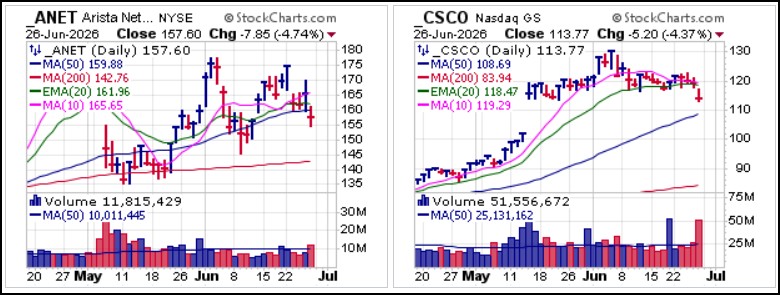
 Big-stock telecoms Arista Networks (ANET) and Cisco Systems (CSCO) both triggered short entries on Friday as well. ANET triggered a short entry as it broke 50-dma support while CSCO did so as it gapped through 20-dema support.
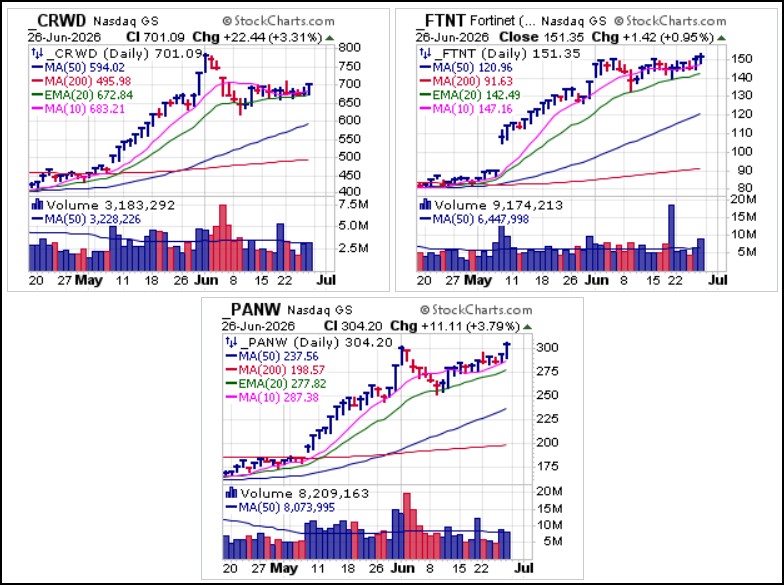
 Bucking the trend in big-stock tech are both CrowdStrike (CRWD) and Palo Alto Networks (PANW) which we first reported on back in early May as they posted BGU moves off and through their 200-dmas. Both stocks continue to base in similar formations with PANW posting a pocket pivot breakout through the $300 Century Mark which is actionable using the $300 level as a tight selling guide. CRWD did not post a pocket pivot but remains in a tight sideways formation along 10-dma and 20-dema support. Fortinet (FTNT), which we reported on as a possible pocket pivot on Thursday fell short on volume but then came back on Friday to post a pocket pivot off the 10-dma.
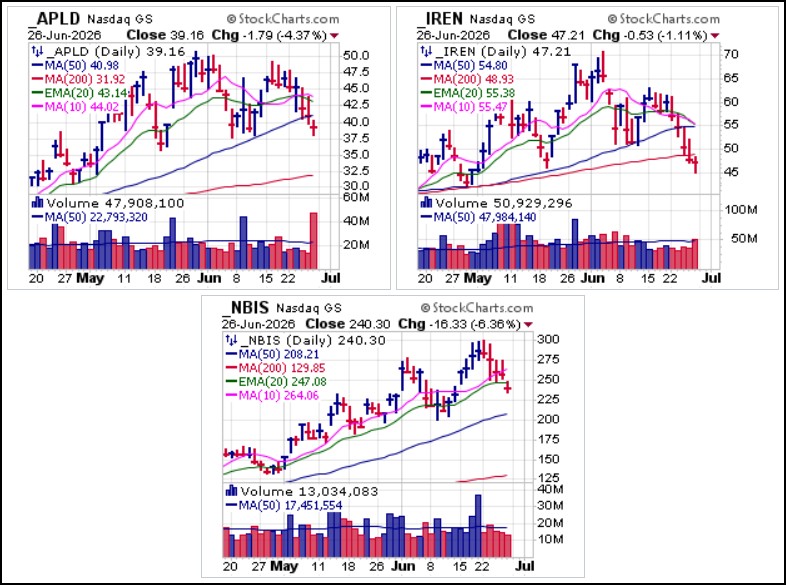
 AI Data Center names dropped like flies this past week. Applied Digital (APLD), IREN Ltd. (IREN) and Nebius Group N.V. (NBIS) all triggered short-sale entries at their 10-dma and 20-dema early in the week. APLD then went on to trigger another short entry at the 50-dma on Thursday while IREN did so on Wednesday before triggering yet another short-sale entry as it busted 200-dma support on Thursday. Nebius Group N.V. was a short along 10-dma resistance on Thursday before triggering another short-sale entry as it broke below the 20-dema on Friday.
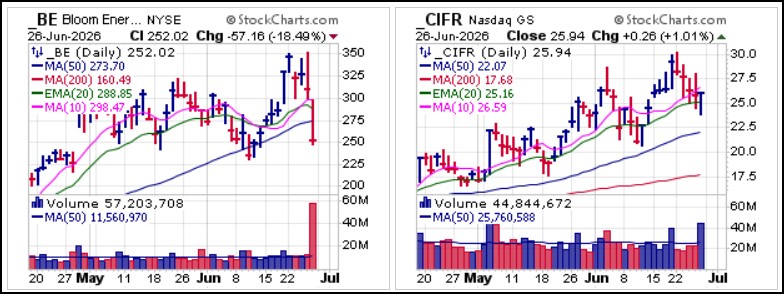
 Also within the AI Data Center space, Bloom Energy (BE) triggered short-sale entries at its 10-dma, 20-dema and finally 50-dma on Friday on very heavy selling volume. Cipher Digital (CIFR) was able to shakeout along its 20-dema and posted a supporting pocket pivot at the line by the close on Friday.
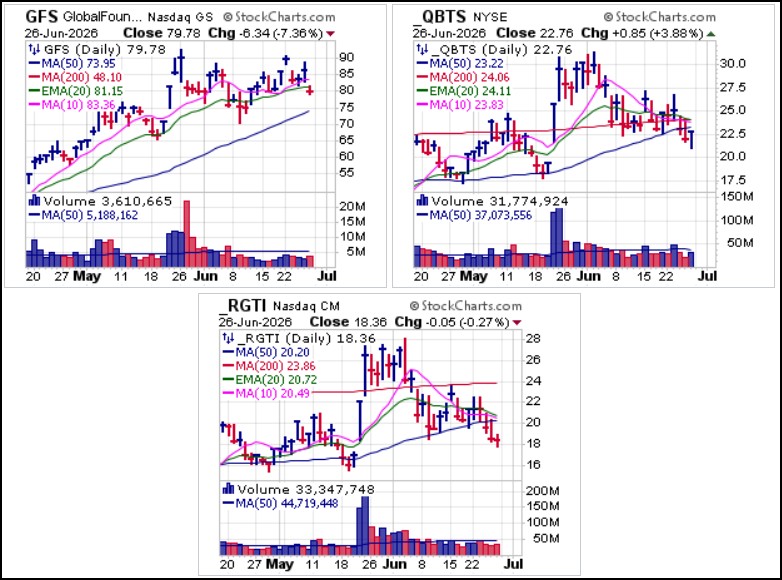
 Quantum computing names D-Wave Computing (QBTS) and Rigetti Computing (RGTI) both triggered short entries along their 50-day lines on Wednesday and Thursday after failing at 10-dma/20-dema support earlier in the week.
 AI-related stocks are coming apart at the seams as the bubble starts to deflate following MU earnings. While MU's results show that demand for their chips remains strong, it is perhaps useful to consider that it is demand that s ever more financed with debt as companies scramble to adopt AI at any cost with little idea of just what kind of Return on Investment (ROI) they will derive when the mad rush is finally over.
The Market Direction Model (MDM) switched from BUY to CASH/NEUTRAL on Wednesday, June 24th and then back to BUY on Thursday, June 25th.