
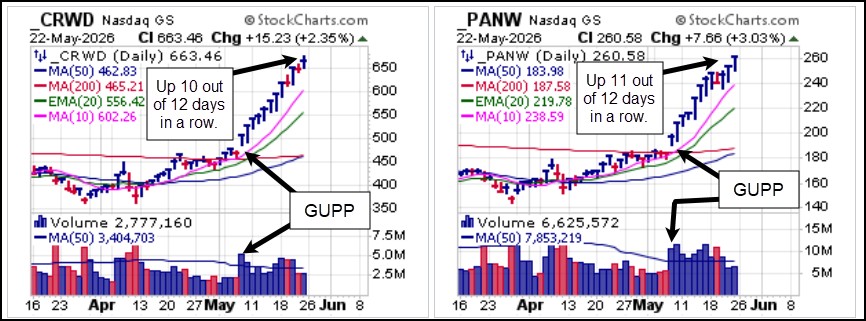
 Way back on May 7rh we reported on big-stock Cybersecurity names CrowdStrike (CRWD) and Palo Alto Networks (PANW) as potential buyable gap-ups (BGU) based on their early intraday volume run rates. By the close, however, neither stock posted enough volume for a BGU. But those gap-up moves have nevertheless led to amazingly persistent, steady, and steep rallies since then. As we noted not too long after those initial gap-up moves, we are seeing the birth of a new set-up, the gap-up pocket pivot or GUPP, where the intraday low of the gap-up day can be used as a selling guide just as it would with a standard BGU. In a FOMO market where the AI theme is now bleeding out into other areas of the market, above-average volume on a GUPP move is more than sufficient to generate a torrid and very profitable uptrend.
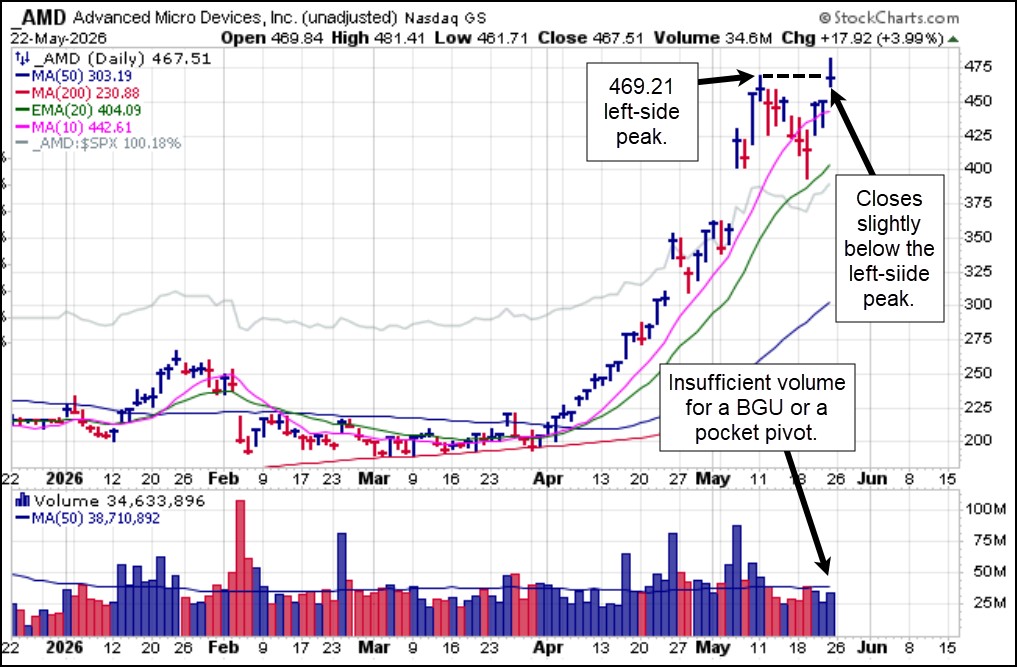
 Advanced Micro Devices (AMD) was reported on early in the morning on Friday as a possible buyable gap-up (BGU) but volume fell well short at down -3.42% below average. Thus it was neither a BGU or a pocket pivot as it stalled off the intraday highs at 481.41. We also reported on a possible short-sale set-up in the stock to be aware of as it makes all-time highs on very weak volume. The stock is quite extended from its early April starting point and the straight down and straight up move off support near the 20-dema over the past four days like has some overhead supply in the way. Whether this is enough to send the stock back towards the 10-dma or even as far as the 20-dema again remains to be seen. Stay tuned.
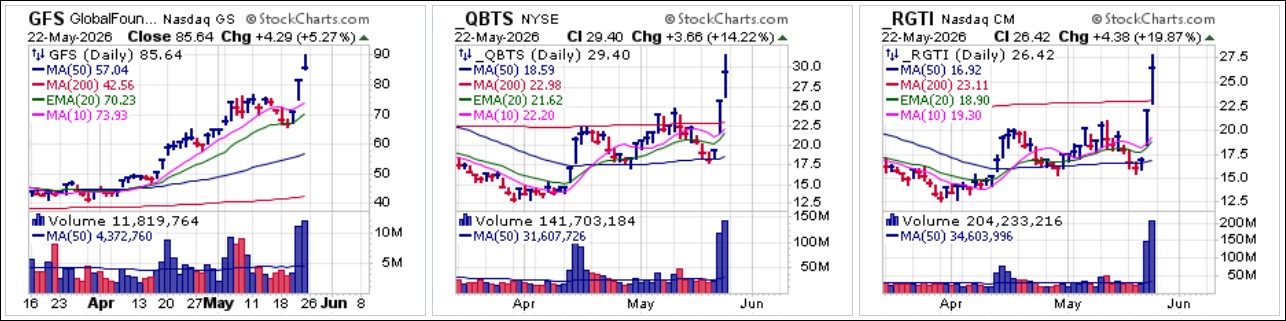
 Quantum Computing names D-Wave Quantum (QBTS), GlobalFoundries (GFS) and Rigetti Computing (RGTI) were reported as BGUs on Friday morning after the three companies were name as beneficiaries of a $2 billion government4 subsidy to the quantum computing industry. All three stocks posted very strong BGU moves on Thursday as they closed near their intraday peaks and the continued higher on Friday as they finally ran into some selling and stalled off the intraday highs. This is understandable given the 50%-plus end-to-end two-day moves in QBTS and RGTI and the 27% move in GFS.
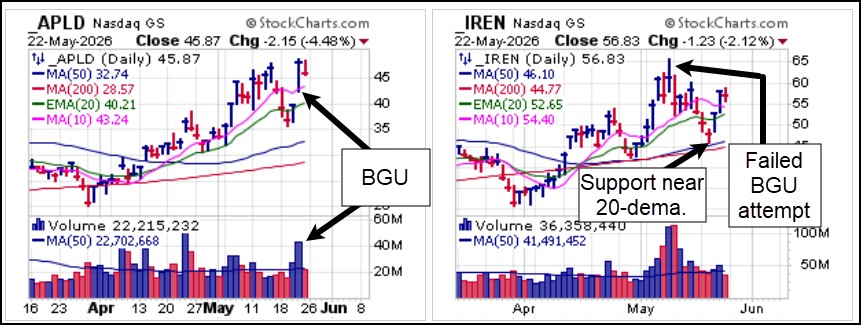
 Applied Digital (APLD) was reported on Thursday as a buyable gap-up (BGU) as the stock closed at a new high. The data center builder and operator announced late Wednesday it had entered into a new 15-year lease agreement with a an unnamed U.S. hyperscaler to build its fourth AI factory campus. APLD then backed off slightly on Friday. APLD is similar to another AI Data Center name that we have reported on from time to time, IREN Ltd. (IREN). We last reported on IREN after it announced a deal with Nvidia (NVDA) over two weeks ago on May 8th. That BGU attempt failed and IREN has since come in to test 20-dema support where it was quite buyable earlier in the week. APLD and IREN tend to pullback after sharp upside moves, so we tend to like these better when they pull in following prior strength, so watch for pullbacks to the 10-dma in APLD from here as opportunistic entries from here.
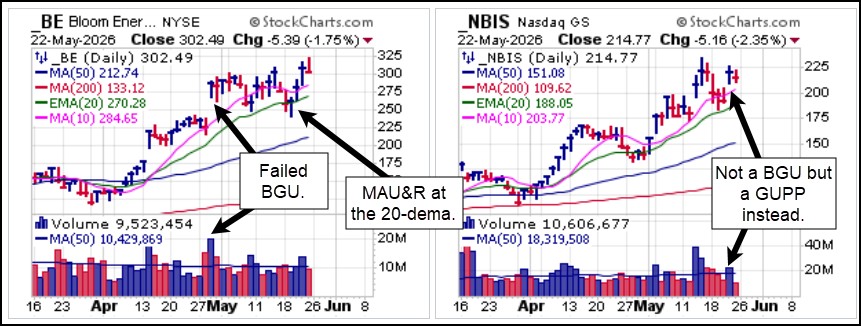
 Bloom Energy (BE) and Nebius Group N.V. (NBIS) were both moving higher on Thursday as well on separate news that they would supply power to AI Data Centers. BE was previously reported on as a BGU back in late April but quickly failed. Note, however, that an opportunistic entry presented itself on an MAU&R at the 20-dema this past Tuesday. Again, opportunistic pullbacks following prior strength is often a better approach than chasing obvious strength in highly extended price moves. NBIS was reported on Thursday as a BGU but volume tapered off as the BGU attempt failed. However, volume was enough for a gap-up pocket pivot (GUPP) and the stock is now pulling back into the Thursday intraday low at 208.80 where it may become buyable as a GUPP set-up. Also note that NBIS is attempting to decisively clear the $200 Century Mark, so a test of the $200 level that holds could set up an opportunistic long entry point on the basis of an actionable Livermore Century Mark long entry.
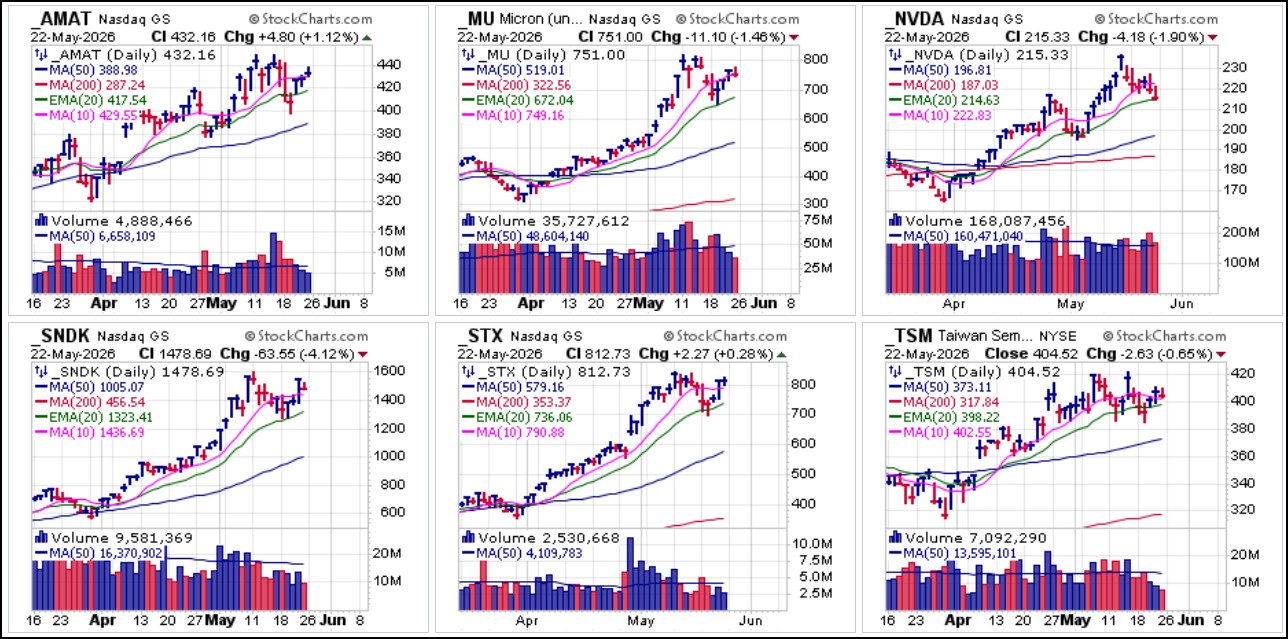
 The AI theme has driven semiconductors sharply higher, and we have seen this bleed into other areas of tech like the Quantum Computing names. We have reported on many of these semiconductors throughout April and May as they have trended higher. More recently, we are starting to see these moves begin to correct and consolidate and it is likely that we are looking at the start of a basing period following strong prior uptrends in most cases. Some may eventually become buyable again as they flash various set-ups within their base. Taiwan Semiconductor (TSM) may be one example after posting a VDU pullback to its 10-dma on Friday within a four-week base.
 Areas outside of the AI thematic space have not been so accommodating, however. For example, numerous uranium stocks that we reported on in April and May have blown apart since. In some cases, however, failures and pullbacks can set up comebacks. For example, we can see how the initial BGU in steelmaker ArcelorMittal (MT) back in early May failed quickly, but an opportunistic entry as it posted an MAU&R at the 20-dema on Wednesday was eventually triggered just as the stock launched on a three-day run to new highs. Likewise, a bug-volume BGU in small modular nuclear reactor maker Nano Nuclear Energy (NNE) went nowhere and eventually NNE broke below 50-dma support this past Tuesday. But that set up an MAU&R at the 50-dma the very next day and now NNE is again pushing back towards near-term highs. Back in early May we reported on big-stock miner Pan-American Silver (PAAS) as it appeared to be posting a BGU early in the day. While the BGU did not pan out, no pun intended, a gap-up pocket pivot off the lows, a BFGUPP we suppose, was posted. That led to a sharp five-day run to higher highs before PAAS came apart. At this stage one could perhaps watch for an MAU&R to develop along the 50-dma. Finally, copper miner Teck Resources (TECK) posted a GUPP after being reported on as a BGU early in the day on May 6th (like PAAS) and that led to more upside before coming apart but recovering with an MAU&R this past Wednesday.
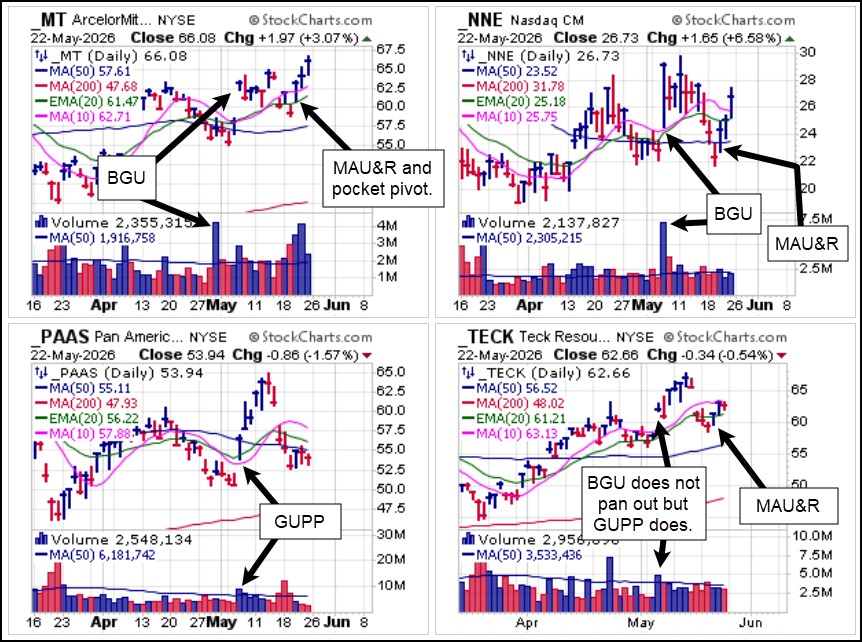 Trading in this market requires some resourcefulness in adapting to the price volatility within the context of typical long set-ups. Often, an opportunistic approach trumps (pun intended) a rush to chase obvious strength as many of these examples shown above illustrate. Studying these examples also gives one a reasonable idea of how various set-ups can materialize in real-time and is therefore instructive. Meanwhile, we stay with what works, we perhaps short what does not as leadership among AI techs remains entrenched while most of the rest of the market struggles.
The Market Direction Model (MDM) remains on a BUY signal.